Site Content

April 23, 2012

Decontamination and the Chemical Suicide

Decontamination and the Chemical Suicide

How were they exposed and what was the chemical? 
Those might be the first two questions you ask when confronted with a chemical suicide or consumer level hazardous materials event. They're also the most important. Figuring out the how and the what can be difficult but is vital to a safe mitigation of the situation. Incident indicators such as product containers and patient symptoms can help with identification. (see Concerns grow as chemical suicide evolves)
Key Point:
You should not rely on your senses to identify chemical products and determine exposure.

Was it accidental or intentional? 
The answer to that question indicates intent and potential secondary hazard. Chemical assisted suicide situations are intentional events  carried out by mixing a variety of chemicals to form a lethal combination. We often think of Hydrogen Sulfide in these cases but Cyanide and other materials have been created as well. Consumer level hazardous materials situations most likely fall outside of an intentional event and may be accidental. We should also consider that chemical exposure can be the result of illicit chemical use - chemical bomb creation or drug production. Regardless of the intent, the cause or the chemical, we have to consider emergency decontamination at these event. (see Managing the Chemical Suicide)
Key Point: 
You may have to search for source of the chemical - at the event location or at prior locations the person has been at  - and send the appropriate resources.

Not all contamination is treated equally
While all contaminated persons should be considered for some level of decontamination, internal and external contamination situations require different approaches.

Maintaining a culture of preparedness
Example of emergency mass decon
Internal contamination is hard if not impossible to decontaminate. The product may/may not be known. Secondary exposure risk is not a "scene only" hazard. The potential threat persists into the transport and hospital phase of care. Once a person has ingested a chemical the risk of secondary exposure to that agent (exposure of other responders/hospital providers) increases substantially once the person has vomited. Vomiting can release the chemical and produce symptoms in those exposed.
Exposure may be in the form of off gassing from internal contamination or exposure to liquid from vomit. Prior to vomiting the chemical is contained within the body with the possible exception of exposure via exhaled breath.

External contamination has the potential for immediate secondary contamination and exposure to responders and health care receivers. Because of the variety of chemicals that could be used, the actual product may not be known. Atmospheric monitoring may be helpful to identify oxygen limited or other toxic environments. Treatment may be determined by the situation and hazardous conditions as access may be delayed while the patient is removed from the toxic environment and decontaminated.

Keys to Decontamination:
  • Decontaminate as soon as possible
  • Use properly trained and protected responders
  • Removing outer clothing of victims may remove > 90% of contaminated material
  • Bag contaminated clothing/items appropriate overpack drum or container - may be evidence - consider chain of custody issues. 
  • Control run off whenever possible -  paramount with radiological materials
  • Don't bring containers or contaminated materials (even if contained) to hospital - take a picture - or video
  • High volume/low pressure water streams may be the fastest and most effective means of emergency mass decontamination
  • Be prepared for outcomes resulting from:
    • environmental conditions
    • privacy and media issues
    • radiation text materials in public
      Sources of information
    •  casualty care issues of hypothermia/re dressing/re warming

Conclusion: Decontamination Points to Remember
  • Decontamination prior to treatment or transport - must be done on site
  • Exposed persons will flee the scene prior arrival of rescuers - contaminated self-referrals pose a risk to hospitals and staff should be on the look out for contaminated persons arriving in the ED
  • Casualties should be triaged to receiving facilities that are equipped and prepared for secondary decontamination
  • The fire department should be involved in decontamination operations at scene and hospital
  • Be prepared for events to take place at non-hospital health care locations - walk in/urgent care centers

April 19, 2012

Managing the Chemical Suicide

Chemical Suicide: Situational Awareness

What's at stake when a person decides to carry out their chemical suicide in a public location and has desire to intentionally injure others? 
There are no rules concerning chemical suicides. Chemical agents, delivery devices, and locations are as variable as the people who attempt suicide by chemical means. A person who wants to carry out a chemical suicide is only limited by their resources and imagination. (see Concerns Grow as Chemical Suicide Evolves, MJ April, 2012)
The risks of multiple patients and potential for additional casualties dramatically increases when the desire to harm others is part of the suicide plan.

  • Japan - Laundry detergent with liquid cleanser in an apartment building. Hydrogen sulfide is created and sickened 90 other people in building.
  • Arizona - one individual manufactured hydrogen cyanide instead of hydrogen sulfide.
  • Oregon - man mixes chlorine, bleach, ammonia and Drain-O and heats on Hibachi grill in a hotel room.
  • Boston - Sodium azide is ingested and subsequently forms  Cyanide causing the evacuation of the building and the quarantine of several responders.

What does a chemical suicide look like?
The first indication of a chemical suicide or consumer level hazardous materials event may come from the caller or dispatch information. The presence of strange odors or the smell of rotten eggs may be reported depending on the chemical used. While some materials give off pungent odors others may have no olfactory warning whatsoever. 

Chemical containers in or around the location may be present. Remember, these containers may be from every-day Consumer Level Hazardous Materials purchased at a local grocery store or garden center. Any unusual cluster or amount of empty cleaning product containers, even if they're same products you see on store shelves every day, should be taken as a warning. There may also be a container used to  mix various products such as large pans or buckets. Pressurized tanks, the size you'd find on a gas grill, may be present if a simple or systemic asphyxiant gas is used. The presence of commercial size containers (pressurized gas or liquid) should be a warning, too.

Chemical suicides can take place in any venue. Many cases have involved a vehicle parked in a public place while others are carried out in residential locations including apartment buildings. Selecting vehicles, residential bathrooms and other small spaces allows for a small amount of gas to quickly reach lethal concentrations. Signs indicating the intent and chemical presence may be used...or not. While confined spaces seem to be the norm, the situation can quickly become a much larger threat if a chemical suicide were to be attempted at an indoor public location as the hazardous materials will escape the immediate area, increasing the potential for unintended persons to be exposed. 

Warning signs if any, may/may not be obvious. If the warnings do exist should we trust them? The potential for additional threats should also be considered. Incomplete chemical reactions, residual products, and flammable/explosive or oxygen deficient atmospheres should be anticipated.

What to do about it
Your first decision may be the hardest...you'll have to decide if this is a rescue or recover? Once that decision has been made the remainder of decisions have to progress accordingly. The actions of the first-arriving units will dictate the progression of the event and the safety of responders and the public. (see First In? Think First, MJ July 2010)

Anyone who enters the space without proper protection may quickly become a part of the problem rather than part of the solution. (see EMS Exposed to Acid, MJ August 2010) Approach to the situation should be cautious, with a high degree of situational awareness. Be prepared for multiple exposed patients. Unintended victims (or intended victims) could be exposed to liquids or gasses depending on the materials used or created as a result of a mixture of materials. Liquid and gas exposures should be handled differently. 

Victims exposed to a gaseous product may not be efficiently decontaminated by mechanical means and initially may pose less risk of secondary (off-gassing) contamination. Those exposed to liquid chemicals may have exterior contamination and require decontamination. Removing clothing of  may remove as much as ninety percent external contamination. Secondary contamination of a rescue crew, ambulance vehicle, or hospital emergency department has to be avoided. All exposed persons and victims of chemical suicides who are receiving care or being transported must undergo the appropriate decontamination. Incidents occurring in public places may call for mass casualty decontamination.

Personal Protective Equipment...what will work, what will not
Standard body substance isolation materials used by EMS or in hospitals will provide little, if any, protection from a chemical hazard.  Air purifying masks and respirators should only be used if the they are compatible with the chemicals used in the event. Filter masks, canister masks, and air purifying respirators will be of no use in an oxygen deficient atmosphere. Self-contained breathing apparatus (SCBA) with structural firefighting clothing should be considered the minimum level of PPE for initial operations or rescue of verified, live victims.

Additional Recommendations:
  • Atmospheric monitoring should take place as soon as possible. Ideally, monitors that are capable of detecting simple and systemic asphyxiants, blood agents, and choking agents should be used. 
  • The most appropriate treatment facility may be one with chemical decontamination and isolation facilities. The facility should be notified well in advance of patient arrival. Fire department units capable of providing or assisting with secondary decontamination should be deployed to any hospital emergency department prior to the arrival of victims.
  • Specialized treatments such as traditional cyanide antidote kits or the Cyanokit should be available as well as a variety of other "tox med" medication. (Cyanide antidote kits will be discussed in a later post). 
  • Chemical suicide events may occurs with or without a hazardous materials team available. You might find yourself responding to, or receiving patients from, these events without the ideal resources...take the responsibility for situational awareness yourself. 

April 17, 2012

Concerns grow as chemical suicides evolve

Chemical Assisted Suicide: Agent Review

Chemical assisted suicides continue to change and challenge emergency responders. Recent cases have demonstrated the ability to utilize various products and expand that challenge to health care facilities and providers. While we've focused much of our attention on Hydrogen Sulfide, cyanide and numerous other chemicals with high hazard potential have been used. For more, follow this link for background information on Chemical Assisted Suicide. In this series Mitigation Journal continues coverage of chemical suicide/blood agent suicide that began in 2008.

Recent Cases:
New York City - a man was found in a running car with an open bucket containing about 10 gallons of unknown chemicals. The car was parked near a "big box" home improvement store. We can only speculate based on media reports, that the open container of chemicals played a role in the death. This situation may have been one of many that mix various chemicals to form Hydrogen Sulfide.  

Boston - a woman ingested sodium azide and subsequently metabolized a form of Cyanide resulting in her death, causing the evacuation of the building and the quarantine of several responders.

Florida  - a man ingests a pesticide, malathion, and was transported to the hospital by EMS. The man vomits, exposing the ambulance crew and hospital providers to the effects of this organophosphate/cholinesterase inhibitor material. (see Are you ready for nerve agent exposure? Mitigation Journal)

The locations are different as are the chemicals used but, they're all part of a growing trend that poses extreme risks to civilians, responders and healthcare facilities.

Review of Chemicals
Various chemicals are used in suicide attempts and can include:
  • Simple Asphyxiants - carbon dioxide, methane, and propane - displace oxygen in an enclosed space, promoting asphyxiation and suffocation by causing an oxygen deficient atmosphere.
  • Systemic Asphxiants - carbon monoxide - exclude oxygen from the red blood cell by altering hemoglobin, decreasing the oxygen carrying capacity of the blood and resulting in hypoxia/hypoxemia .
  • Blood Agents - Cyanide/Cyanide forming compounds, Nitrates, and Sulphides. Hydrogen sulphide, hydrogen cyanide, cyanogen chloride are major concerns. These materials interfere with cellular respiration and result in cellular hypoxia. Each of these products are toxic and can lead to rapid death. 
  • Choking Agents - Chlorine and Phosgene - stress the respiratory system and the respiratory tissues. Exposure to choking agents results in mechanical compromise as well the potential for chemical damage that may result in pulmonary edema. 
  • Consumer Level Hazardous Materials -  hydrogen peroxide, acetone, drain cleaners, and bleaches - can be combined to create toxic environments. Commercial pesticides may become contain hazards similar to chemical never agents.
Many drain cleaners contain sodium hypochlorite (bleach) and lye, an oxydizer/caustic. Chlorine (bleach) mixed with an acid creates chlorine gas and chlorine gas combined with ammonia results in chloramine gas. All of these materials are severe inhalation and contact hazard.

Many cases of chemical assisted suicide, sometimes described as detergent suicide, involve some form of bathroom cleaner (acid), pesticides (sulfur) , laundry detergent (chlorine), and in some cases bath salts (not the synthetic drug type). Hydrogen sulfide is created by combining acids and sulfides with other materials. There is usually some type of mixing container and empty chemical containers nearby.

In some instances, chemicals have been combined and created other materials that have resulted in differing signs and symptoms including those similar to nerve agent exposure with a similar toxidrome.

The details of the chemicals presented in this post are presented solely for the benefit of responders and health care providers. The intent is to increase the awareness to the growing threat of chemical suicide and Consumer Level Hazmat situations.

April 12, 2012

London Olympics: A Biological Ground Zero?

The 2012 Olympics in London are at risk of becoming the next pandemic ground zero according to research conducted by Maplecroft.

The bad news is that London is only part of the story.
Singapore, North and South Korea, Italy, Germany, Netherlands, Belgium, France, and Spain make the extreme risk of pandemic list, too. None of them are hosting an Olympics, yet are on the same list with the same extreme risk ranking. Confusing? No so much.

Many of the countries noted by Maplesoft are at risk of flu spread as a result of environmental and living conditions. South East Asia is noted in the report as being "a particular risk of emerging strains of influenza" and China is noted as a particular concern. This should not be a surprise. We've been following the development of widely publicized diseases like Avian Flu from these areas for several years. What's different is our level of awareness today. We recognize that global events that bring so many people together from diverse locations brings with it increased disease spread potential.

What makes the 2012 Olympics in London different?
Nothing. In fact, the risk of disease transmission is not unique to  the London Olympic Games in any way. We would be having this same conversation if the Games were being held in Lake Placid, NY or Beijing, China. Mass gatherings have the potential to spread disease, influenza or otherwise. We discuss influenza most often because of the attention drawn to influenza A - H1N1/Swine Flu and H5N1/Highly Pathological Avian Influenza. Although they top the list of notable flu viruses, it's important to remember there are many other diseases of concern. These diseases hold threat potential regardless of the location of the event. The fact is simply highlighted because of the diverse population and environments the athletes and spectators will be coming from. Immune system status, comorbid conditions, and overall state of health of attendees will also be factors in the spread of disease. People will bring diseases as diverse as the culture and health environment they come from...and they'll take other diseases home with them, too. We should also consider the fact that the Olympic Games will be a high-profile event that may be an attractive target for a variety of threats including the biological bomber. Read more: YOU, the biological bomber

What may be different today is our awareness and sensitivity to the biological threat. 
Naturally occurring or intentionally released, a biological agent can be an extraordinarily deadly situation. Perhaps worse than a nuclear detonation, without the big bang, if you will. The good news is that, when compared to other threats, the biological event may be able to be contained and person-to-person transmission limited by simply washing your hands and wearing a mask. The non-pharmacological interventions go a long way to slow the spread of disease and support vaccination efforts. Read more on non-pharmacological interventions.

Technology is a new ally in disease tracking. As described in this video clip from Reuters, public health officials from all over the world are working to improve disease tracking before, during, and after the London Games.

How will the media respond to athletes and attendees at the London Games wearing masks?
This would not be the first time the issue has come up. The United States Cylcling team came under scrutiny for wearing face masks during the 2008 Olympic Games in Beijing. Pollution and air quality prompted the athletes to don the masks and subsequently sparked political issues between China and the U.S. Masks for pollution is one issue. Donning masks to prevent the spread of disease is quite another. Consider the global impact if we were to hear of a "flu-like" illness spreading through London and, at the same time, see athletes wearing N95 masks. It wouldn't take long for the speculation of an outbreak to be spun into the next pandemic.

Preparedness, of course.
There is another side to the threat...preparedness. The widely cited Maplecroft report clearly describes the 10 nations most at risk for pandemic influenza. What is less often noted is that this same report ranks an areas ability to contain a disease. This same research concluded that the U.K. is one of the countries most likely to be able to contain an outbreak:
"...the UK’s strong governance, highly developed infrastructure, well educated population and advanced health system also places it among the 10 countries with the highest capacity to contain a potentially lethal outbreak of a strain of flu." - quoted from Maplecroft.com
What's less clear is the preparedness in other countries. Attendees and athletes will return home with whatever (if anything at all) they've been exposed to. While strong infrastructure adds to resiliency, the lack of that infrastructure will add to disease complication and management. Read more on flu and biological preparedness.


April 5, 2012

Looking for Preparedness Guidance? Add this to your reading list

Standard to Sufficiency: IOM Framework Paves the Way

Crisis Standards of Care: A Systems Framework for Catastrophic Disaster Response has been released by the Institute of Medicine and should be required reading for anyone who participates in emergency preparedness.

When disaster strikes changes have to be made. Planning has to turn into action. Public health, emergency medical service, and hospitals will be faced with tremendous pressure to do the best for the most with what they've got. I call this situation switching from a Standard of Care to a Sufficiency of Care - the latest publication from the Institute of Medicine (IOM) calls it Crisis Standard of Care. The Tenent Health/Katrina decision reinforced the health care planing message...IOM tells us how to do it -

IOM defines three levels of care:
  1. Conventional Care
  2. Contingency Care
  3. Crisis Care
Overview
Crisis Standards of Care document totals over 500 pages divided into easy to digest volumes that target key pillars of Hospital Care, Public Health, Out of Hospital Care, EMS, and Emergency Management/Public Safety. The standards are built on a platform of ethical considerations and legal authority that segue into other critical, but often ignored, components such as community engagement and creation of incidents and triggers for action.

A key to this document being noteworthy is the detailed incorporation of emergency medical service, out of hospital care and public health.While most preparedness documents clump these disciplines under the health care umbrella, IOM takes a refreshing stance by giving each of these disciplines receives appropriate attention and legitimate planning guidance. The quality doesn't stop there; IOM goes even further, including at-risk populations, palliative care, home care, and walk in/urgent care centers as contingencies for planning.

Planning
Template from IOM document
Hospitals have a "duty to plan" and the framework for planning and plan development is exceptionally easy to follow. Step-by-step guidance is given in terms that are easy to understand with a process that has a natural flow and will be a nice addition to your 96-hour planning. Based on my experience, this process with integrate well into existing planning workflow. Following the IOM planning template may also help you avoid my 7 Surefire Tips for Emergency Plan Failure. I also recommend a review of the 6 items that good plans have that bad ones don't.

Training
Recommendations are made for the inclusion of tabletop exercises (TTX) as a means to testing plans created under this framework. TTXs are my favorite training exercise; they are fantastic activities that can be accomplished with a reasonable amount of preparation and very little funding. Follow these links for more on  tabletop exercises and exercise design. See also my five tips that will enhance your exercise design program.

Review
The IOM Crisis Standards of Care -
  • includes template guides for palnning
  • includes EMS, public health as major players 
  • accounts for mental health, palliative care and at-risk populations
  • call for tabletop exercises
Includes recomendations for -
  • establishing trigger points for switching between conventional, contingency, and crisis care
  • modifications for protocols/authorized use of CSC in planning
  • guidance for liability protection and reimbursement
Recommended areas of focus -
  • Volume 3: EMS
  • Volume 4: Hosptial
  • Volume 5: Alternate Care

April 3, 2012

How ready are you for a nerve agent exposure?

Latest Chemical Suicide Attempt Prompts HazMat Response

Consumer Level Hazardous Materials (CLHS) continue to prove their devastating potential. Chemical suicides and chemically contaminated persons may cause evacuation and closure of your emergency department. Unfortunately, these situations and their potential continue to go largely ignored.

FOX News is reporting on a situation in Florida involving a person who attempted to take his life by drinking a chemical pesticide. The man later vomited, releasing the chemical and causing paramedics to become ill and the emergency department to be closed for hours.

What would happen in your health care system if just one emergency department was closed from chemical contamination? 
Suicide by blood agent, often called chemical or detergent suicide, has been growing in popularity for years. These situations continue to be a threat and have evolved with the use of various chemical products. Hydrogen Sulfide is one of the main chemicals of concern as are cyanide and phosgene.  These events are often carried out by mixing the requisite chemicals in a vehicle parked in a public place. Follow these links for more on chemical suicide in cars and chemical suicide in general. Cyanide was used in a Kansas suicide in 2010.
 

The chemical used in the Florida event was the pesticide Malathion, an organophosphate/cholinesterase inhibitor that can cause a toxidrome similar to that of chemical nerve agents.  Organophosphate nerve agent exposure can result in a variety of symptoms including the "Killer B's" of bradycardia, bronchospasm, and bronchorrhea. Nerve agents in this class block the effects of acetycholinesterase (AChE) and result in hyper-stimulation of effected body systems. 

In contrast, blood agents (Hydrogen cyanide, cyanogen chloride, and hydrogen sulphide) interfere with cellular respiration and result in hypoxia. They are highly toxic materials and result in rapid death. Chlorine and phosgene are known as choking agents and stress the respiratory system and cause edema in the lungs. 

You don't have to wait for a terrorist attack to think about these chemicals. 
I discuss all of these materials in Maintaining a Culture of Preparedness - a talk designed to draw parallels between terrorist attacks and everyday Consumer Level Hazardous Materials events. 

I encourage everyone to:
  1. Review their agency policy on decontamination and chemical protection  and inventory
  2. Review your hospital emergency evacuation plan - is it realistic? 
  3. Review your plans for mass fatalities and management of chemical casualties
  4. Have your plans reviewed by an independent evaluator and test your plans with preparedness  exercises. If you'd like help with plan review and exercise design, contact me 
Follow this link for a summary of Mitigation Journal podcasts about chemical suicide.
Special thanks to Mike for sending the original article

March 8, 2012

Is your Preparedness Expiring?

Who should pay to prepare? 

Under the premiss of Homeland Security and preparedness, New York State Bureau of Emergency Medical Services (NYSBEMS) undertook an aggressive initiative to arm EMS providers with  auto-injectors to be used to treat people exposed to certain types of chemical agents. As the expiration dates on these materials begin to come due, NYSBEMS, citing budget constraints, has no plans to replace these auto injectors.

If auto injectors for chemical antidotes were so important three years ago, why aren't they important now? The fact is that having auto injectors on ambulances is not an important component of preparedness now. They never were. And the situation leaves a problem of perception. This situation is the latest example of unrealistic resources being put into play without a sustainable plan under the failed model of Homeland Security. It's an issue of poor planning, of being reactionary -  rushing to do something in the name of Homeland Security, in this case, putting auto injectors on ambulances where they'd most likely never be used by EMS personnel who, by an large, lack the personal protective clothing to operate safely in a chemical environment.

Chances are that public service organizations and public health departments in your state are facing (or will face) budget issues that will force similar decisions. New York is not alone, and New York State Bureau of EMS is not at fault for these items expiring without replacement.
The new post 9/11 era message to emergency response and public health: we're out of money...pay for preparedness yourself or don't do it at all.
This issue goes beyond any single item, it's  and issue of sustainable preparedness. Was it ever realistic to place chemical agent antidote injectors on ambulances in the first place? Probably not. And, now that they're not going to be replaced, gives the impression that this initiative is no longer important or the threat is no longer present.

What we're seeing now is the result of a steady, predictable decline in preparedness funding, planning, and operation. EMS has never received an amount of preparedness dollars commensurate with their function and this de-funding of EMS preparedness will continue to hasten the eventual collapse of  public health.

The term Homeland Security does a disservice as it brings to the public mind an image of guys with guns and scanners at the airport or big shinny fire trucks...leaving public health, healthcare systems, and Emergency Medical Services poorly funded, trained, prepared.

When nothing happens, nothing happens. And nobody wants to pay when nothing happens. 

March 5, 2012

Bath Salts: stronger than dirt

A new "Ivory Wave" of synthetic drugs


PumpIt!, Ivory Wave, and Bath Salts are just a few of the label names of synthetic drugs that are causing intoxication similar to Ecstasy and methamphetamine. These synthetics are often sold in convenience stores, on line, and in your neighborhood may also be labeled as an enhanced plant food...some printed with the warning "not for human consumption". Few, it seems, are heeding that warning as the Centers for Disease Control (CDC) and National Institute of Health (NIH) are calling attention to the growing numbers of emergency department visits, hospital intensive care admissions, and deaths linked to use of Bath Salts. As a example to their popularity, YouTube hosts hundreds of videos on this topic.

Not unlike other drugs, these materials are being swallowed, snorted, smoked, injected or otherwise consumed by a growing population that crosses age, economic, and social barriers. 

From K2Incenseonline.com
What's in this stuff? 
Common chemical ingredients include:
  • Cathinone - a monoamine alkaloid that is similar to ephedrine and amphetamine. Cathinone  has toxic side effects of anorexia, anxiety, irritability, insomnia, hallucinations and panic attacks. This chemical is also known as Khat and is found in plant food.
  • Mephedrone  - a substance known to produce methamphetamine-like reactions in rats.

Patient presentation
Bath Salts, PumpIt! and similar drugs have been compared to a combination of Ecstacy, cocaine and methamphetamine.  According to both CDC and NIH consumption of these and similar products results in symptoms resembling stimulant overdose. Since these drugs often lack an immediate effect, users  frequently increase their intake resulting in overdose situations with neurological and cardiovascular dysfunction including acute myocardial infarction (AMI). Rhabdomylysis has also been reported.

The major psychiatric componant associated with these materials is a psychosis that can last for days. psychotic symptoms may include:
  • loss of contact with reality
  • false beliefs 
  • hallucinations/delusions
  • disorganized thinking and speech 
Patients testing positive for Bath Salt use often test positive for other substances. Be on the lookout for indications and side effects of polypharmaceutical overdose!
If all that's not good enough, intramuscular injection of Bath Salts is linked to aggressive cellulitis and necrotizing fasciitis or flesh eating soft tissue infections. For more on the link between cellulitis/necrotizing Fasciitis see this report from Z6Mag

Its like methamphetamine, cocaine, and Ecstasy...not exactly. 
Image from Z6Mag
  • Like meth, Bath Salts cause a spike in dopamine levels causing users develop a craving quickly.  "Dopamine burnout" is a factor in the abuse potential.
  • Like Ecstasy, there is an increase in serotonin. With continued use, an eventual inability to react to serotonin develops and is related to increased use and binging. 
  • Like both meth and Ecstasy chronic use increases the risk of personality disorders and AMI
PumpIt! has an added twist. This product contains Methylhexanamine, a chemical created in 1944 as a nasal decongestant/vasoconstrictor. Side effects/toxic effects are similar to caffeine and stimulant overdose and include the discussion above with the added increased risk of hyperpyrexia due to a strong thermogenic properties.

Treatment
Treatment is mainly supportive and based on symptoms. Sedation, benzodiazapine, and anti psychotics may be used (refer to local standards). Because of the risk of polypharmacy use, treatment and recognition may be difficult.

Scope

As reported in Morbidity and Mortality Weekly Report (MMWR), May 2011, and in numerous other publications, the scope and severity of this situation is increasing. According to the MMWR report, in a sampling of 35 patients who reported to a Michagan emergency department had the following findings:
  • symptoms similar to stimulant intoxication
  • 32 patients had neurological symptoms
  • 27 patients had cardiovascular symptoms
  • many tested positive for other drugs
  • Hospital admits were to the ICU, medical floors, and psychiatry 

Operational Considerations
There is an increased risk of multiple patients becoming intoxicated with these substance when used in groups. There may be risk for multi patient events. Be on the lookout for commonalities in patient complaints and presentations.

Further Information
The following links were helpful:
Centers for Disease Control and Prevention (CDC) www.cdc.gov
Morbidity and Mortality Weekly Report http://www.cdc.gov/mmwr/
National Institute of Health (NIH) http://www.nih.gov/
YouTube > search keywords: Bath Salt, Spice, K2, Ivory Wave, PumpIt! Power Drug

March 1, 2012

Healthcare Providers Targeted by Violence

Physician Shot in Baltimore Hospital...Reminding us that hospitals are Soft Targets.

A lone gunman entered Johns Hopkins Hospital and became upset over his mothers condition. According to CNN.com, the man pulled out a pistol and shot a doctor. He returned to his mothers room and is believed to have shot her, and then shot himself. Also, according to the original CNN.com article, the hospital gets 80,000 visitors and has at least 80 doors that makes security difficult.

We've talked about Soft Targets many times before. Anyplace that lacks deterrents to an attack and holds value as a target (ie place of critical infrastructure) is a soft target. Hospitals are locations of critical infrastructure.
"It's important to understand that open structures with multiple access/egress points, isolated utility and services corridors and large crowds are potential target hazards for multi-patient, mass casualty events. Remember, we're not just talking terrorism here...gang activity can cause collateral damage as well as structural collapse, fires, panic situations, and of course, intentional events." (Hospitals, Hotels, Malls - Soft Targets December 2, 2008 Mitigation Journal)
 I wrote the above quote almost two years ago in response to an attack in India (see Why hotels are easy terrorist targets in MSNBC.com). The reminder has to be that we continue to have locations of critical infrastructure that are open buildings, lacking any deterrent. That is, they're a soft target. Violence against health care workers has been an issue of growing concern for several years. Most cases of violence in hospitals occur in the emergency department, while other less predicable events can occur on any floor.

The recent shooting of a physician at Johns Hopkins Hospital underscores that unpredictability. According to a follow up article from CNN.com, the shooters mother was paralyzed as a result of recent surgery. It was that bit of bad news that caused the man to shoot the physician, his mother, and himself.


The Johns Hopkins event is only the latest in a growing trend of hospital violence. According to this MSNBC.com article, most physicians do not feel safe in their workplace. The rate of attacks and violence is particularly disturbing in emergency departments as noted by MSNBC.com in Assaults on ER nurses rise as programs cut.


While there are no simple answers to the growing violence problem, there are non-intrusive countermeasures. We spoke with representatives from Net Talon on Mitigation Journal Podcast (listen to MJ# 187 here) talking about active shooter situations and solutions. You can also read my posting Active Shooter Brief in Mitigation Journal Blog, July, 2010.


The bottom line on all this is that we must harden our soft  targets...including hospitals...no matter how difficult the task. As tragic as the Johns Hopkins and other events are, they could be much, much worse.

February 23, 2012

Is it time to evacuate the hospital? 96 Hour Planning Part Two

96 hour planning as a decision making tool

How do you decide when to evacuate your hospital or healthcare facility? Who makes that decision and what resources are called into action? Chances are these things are covered in your emergency management plans. But how do you know when its time to activate those plans? Your 96 hour plan can help identify trigger events and make the evacuation decision.

Part one of this series on 96 hour planning discussed the Joint Commission on Healthcare Accreditation (JC) requirement for  emergency planning on the part of hospitals and healthcare facilities. We discussed the need to have an operational plan that sustains the facility when access to external resources are no longer available. Commonly known as the 96-hour plan, healthcare facilities must prove that they've considered the possibilities and impact on operations when they become cut off from the rest of the world by some catastrophic event. 96 Hour planning may be seen as something of a fuel gauge to manage inventory and as a means to survival for the facility. The process includes an assessment of materials on hand and consumption rates. Like other disaster plans, the 96-hour plan must integrate the facilities Hazard Vulnerability Assessment (HVA), existing community response plans and identify the ability to sustain communication, resources and assets, security and safety, staff, utilities and patient care.

The decision to shelter in place or evacuate is not a one-time-only event. This critical decision requires continual reevaluation and situational awareness. While keeping tabs on the external situation or crisis at hand is vital, it is equally important to understand how long you can safely remain in your location and continue to operate. These points are actually the premiss for doing an self-evaluation and creating a 96 hour plan. The value of this process is seen when you realize how the amount of supplies and materials you have (or don't have) on hand and how long your stockpile will last. In other words, given your occupancy rate, how fast will you consume these materials. One way to start this process is by asking how bad can this situation get or what if it did happen here?

This same process can be used to make the switch between standard of care and sufficiency of care. Let's define standard of care as the way we do business every day, with our normal resources and operation. With the normally available resources limited only to what we have stored (no resupply) how long will they last during normal operation? Chances are you'll recognize that you cannot (nor should you) maintain the standard of care (normal operation) when you access to outside resources are cut off the resupply becomes impossible. Switching to sufficiency of care means you'll do what you can or the minimum needed to keep the situation from getting worse. You may be faced with the burden to decide who lives and dies during disaster. Based on the findings of your 96 hour planning process you may:
  • Choose to conserve in-house resources early
  • Supplement with community resources if availble
  • Close to new patients (if that's possible) or redirect incoming people
  • Maintain staff for extended operational periods
  • Consider limited or full evacuation
The 96 hour plan as part of your larger emergency management plan and can help on your search for preparedness. These plans must include assessment of agreements with vendor/suppliers as well as a means of monitoring and reporting on the status of in-house materials. 

February 21, 2012

96 Hour Healthcare Emergency Planning Part One

Why a 96-Hour Plan?

The Joint Commission on Healthcare Accreditation (JC) requires emergency planning on the part of hospitals and healthcare facilities. Part of that preparedness requirement is to have an operational plan that sustains the facility when access to external resources are no longer available. Commonly known as the 96-hour plan, healthcare facilities must prove that they've considered the possibilities and impact on operations when they become cut off from the rest of the world by some catastrophic event. 96 Hour planning may be seen as something of a fuel gauge to manage inventory and as a means to survival for the facility. The process includes an assessment of materials on hand and consumption rates. Like other disaster plans, the 96-hour plan must integrate the facilities Hazard Vulnerability Assessment (HVA), existing community response plans and identify the ability to sustain communication, resources and assets, security and safety, staff, utilities and patient care.

96 hour planning is an excellent addition to your Emergency Management to-do list. 

Not sure how to start planning? Check out Pre-incident Planning and see What Good Plans Have and Bad Ones Don't

A solid 96 hour plan will help decision making when changing from a standard of care to a sufficiency of care, evacuation or conservation of resources. While the JC does not require stockpiling of supplies for the planning period, the expectation is that advance planning will take place and a process will be created to aid in decision making. Organizations that undertake a realistic approach to this planning will come away with and improved understanding of how resources and assets are used for daily operations. This level of planning is also relevant to other forms of emergencies such as biologic events and other threats.

Need help writing a biologic response plan? See How to Write Your Biologic Plan

The Tenent Health decision illustrates the need for 96-hour or resiliency planning for disaster operations and sets a tone of responsibility. Get the full Mitigation Journal two-part review on the Katrina/Tenent decision check out A Message from Katrina. Healthcare facilities must prepare for the following eventualities during a disaster:
  • Discharges from the hospital will be limited - limitations in travel as well physical damage to roads and residences will make discharge of patients difficult.
  • There will be a surge in patients seeking care - healthcare institutions will be seen as an area of refuge and people will expect some level of care in the form of shelter and food. At-risk and special needs populations will self refer in anticipation of need as well.
  • Supplies and materials from fuel to water will be limited if not impossible to obtain from vendors and routine delivery of supplies and materials will not occur. Facilities will be left with what they have on-hand.
See 7 Healthcare Preparedness Things You Need to Know for more on healthcare planning.

Hospitals must be considered critical infrastructure by local government and protected accordingly. With that said, healthcare facilities retain responsibility for the care of patients and support of staff during catastrophic events and must plan to be self sufficient.

February 18, 2012

MJ Podcast #232 Emergency Management/Social Media

A conversation with Emergency Management/Social Media blogger, Todd Jasper

Click to subscribe to MJ free

I recently had the pleasure of speaking with Mr. Todd Jasper on the topic of emergency management myths and realities, social media, and emergency notification. Todd is the Associate Director of the Homeland Security Division of MSA and has added his expertise in preparedness to the social media world through his blog, toddjasper.com.


Click the player below to listen now.

January 30, 2012

MJ Podcast #231 Cruise Ship Medicine


                                An introduction to life as a Chief Medical Officer with Evelyn B, Sklair, RN, EMTP

Subscribe Free
How would you like to live and work on a cruise ship? That's exactly what today's guest does! Evelyn Sklair, RN, EMTP is a Chief Medical Officer for Holland America Cruise Lines and she is going to share with us what its like to work (and live) in this unique environment.

Evelyn is a Registered Nurse and has been active in EMS as a Paramedic for many years. She was instrumental in the development of prehosptial care at the Eastman Kodak Company and an EMS leader in Monroe County, NY for many years.


Click on the player below for this weeks podcast

January 26, 2012

The Coming Public Health Collapse

Co-posted on Genesee Valley Nurse
Click here
The Anthrax attacks that followed in the days after 9/11/01 reminded us of the need for public health emergency preparedness.

Public health efforts have vaccinated millions, crushed Polio, and eradicated Smallpox, and they've done so while operating in the background of emergency management in relative obscurity...until September, 2001. The Anthrax attacks provided a wake up call to the Nation that our public health system was vital to the effectiveness of domestic preparedness efforts. Public Health was thrust into the public safety arena. With emerging biologic threats that jumped off the pages of a novel and into reality, it looked as if public health was destined to remain a part of the new traditional responder group.

Not so fast.

In Ready or Not? 2011, Protecting the Public from Diseases, Disasters, and Bioterrorism, the Trust for Americas Health reports that "key programs that detect and respond to bioterrorism, new disease outbreaks and natural or accidental disasters are at risk due to federal and state budget cuts."

We're still searching for preparedness in America. Rather than continuing to support efforts to maintain a durable healthcare/public health preparedness system, we're going to go backwards.
"We're seeing a decade's worth of progress eroding in front of our eyes," said Jeff Levi, PhD, Executive Director of TFAH. "Preparedness had been on an upward trajectory, but now some of the most elementary capabilities - including the ability to identify and contain outbreaks, provide vaccines and medications during emergencies, and treat people during mass traumas - are experiencing cuts in every state across the country."
Here are a few examples of the capabilities that will be lost:
  • 51 cities at risk for elimination from the Cities Readiness Initiative
  • 10 state labs at risk for losing "Level 1" chemical testing abilities
  • 24 states at risk to lose Career Epidemiology Field Officers
  • 14 universities at risk to lose Preparedness and Emergency Response Learning Center funds
Why? Because when nothing happens, nothing happens. And nobody wants to pay when nothing happens. We've seen concern and hype over SARS, Avian Flu, Swine Flu - and nothing not much happened. Our impression of preparedness is high visibility people with uniforms, badges, guns under the failed approach of Homeland Security. Healthcare and public health operate in the background of preparedness and lack that high visibility until some biologic threat is exposed. Then, and only then, is the value of a durable healthcare/public health system realized...temporally. Katrina reminded healthcare systems to be ready. How can they be if they're not assisted with the same level of resources afforded to other Homeland Security measures?

Preparedness for biologic events, natural or intentional, requires funding to remain constant for healthcare and public health. That funding needs to be on par with other traditional response groups. Without healthcare/public health we will face what it  means to live or die in disaster.

Failure to maintain healthcare/public health durability will worsen the ripple effect from biologic events by increasing strain on traditional responders and healthcare systems and by worsening the impact on special needs and at-risk populations. These things add up to poor outcomes from natural or intentional biologic events. Poor outcomes that can be predicted, and prevented if we'd change the way we think.

January 24, 2012

Get this Biosecurity app before your next shift

Co-posted on Genesee Valley Nurse
The Clinicians Biosecurity App for healthcare providers from the Center for Biosecurity of UPMC is one app you'll want before your next shift.

Home screen on iPad
The Center for Biosecurity of UPMC has released their latest app for iOS. The Clinicians Biosecurity Resource (CBR) App covers the basics of several diseases with feature rich content for further leaning. CBR easily overpowers their prior offering, BioAgent Facts app. Click here for my review of the BioAgnet Facts app.


Disease list on iPad


The CBR app covers six diseases with enough detail to make this a worthwhile reference to assist in the recognition of a naturally occurring or intentional biologic event. The information for each pathogen is broken down into categories and is  referenced to fact sheets from the Centers for Disease Control and Prevention (CDC) and he Center for Biosecurity. The value of the CBR app is increased substantially by the addition of sections for each pathogen on naturally occurring states, post exposure prophylaxis, personal protective equipment (PPE). The content is digestible, concise, and easily accessed through the apps interface. Images of x-ray findings are included (see Anthrax below).


Access to Biosecurity News
Notification option
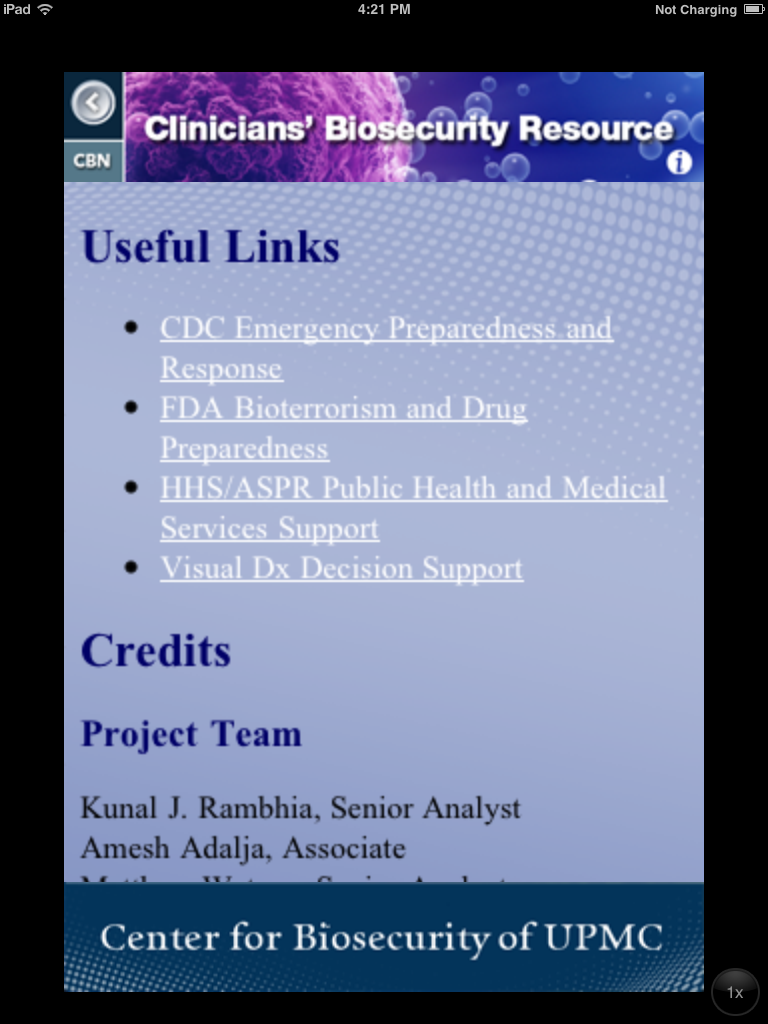
You can also access Clinicians Biosecurtiy News (CBN), published twice monthly, directly from the home screen. Clicking on the wrench icon on the CBN page provides an option to be reminded about CBR updates. The information icon (i) links to the 'about' page containing a disclaimer, developer credits and additional links for reference.

Typical bioagent page layout shown below (Anthrax page as example)


The Clinicians Biosecurity Reference (CBR) will be useful for emergency medical service professionals, nursing, as well as physicians. The layout/design and feature rich content take this app above and beyond. Navigation and user interface are simple and CBR runs smoothly on iPhone/iPad running iOS 5.0.1. The color scheme is much easier to read than BioAgent Facts. I highly recommend the CBR app.


Final Score 0-5: The CBR app gets a 4.5
Content: 4.5 Solid information from a trusted resource, easy to access and scan. External links to CDC and Biosecurity News add value. CBR app can go a long way being used as reference and learning tool. Dumping the Zombie section (as seen in BioAgents Facts) and adding sections for Naturally Occurring, PPE, and Post Exposure information is a major improvement.

Aesthetics/graphics: 4.0 Detailed graphics and color combinations that are easy on the eyes.

Ease of Use: 4.5 I found the tabs/buttons easy to navigate. Text is clear with pleasing color combinations. Stable on an iPhone/iPad (iOS 5.0.1) there is no clear support/FAQ available.

Wishlist for CBR:
Allow screens to rotate. This would be especially helpful for iPhone.
Enable gestures. Again, a big advantage for iPhone

January 19, 2012

Fight Fatigue, Reduce Error

The Joint Commission says fatigue risks patient care

The Joint Commission has issued a position warning  healthcare agencies to fight medical errors by fighting fatigue. Citing the link between health care worker fatigue and adverse patient care events, the Joint Commission revisited the issue of extended shifts and fatigue in a recent Sentinel Event Alert. 

According to the Joint Commission: 
Fatigue resulting from an inadequate amount of sleep or insufficient quality of sleep over an extended period can lead to a number of problems, including:
  • lapses in attention and inability to stay focused
  • reduced motivation
  • compromised problem solving
  • confusion
  • irritability
  • memory lapses
  • impaired communication
  • slowed or faulty information processing and judgment
  • diminished reaction time 
  • indifference and loss of empathy
 In 2007, the JC noted that strong evidence exists linking medical error, fatigue, and extended duration shifts. The findings indicate that exteded shift and night shift workers make 36% more serious preventable adverse errors than others and have a 61% more needlestick or sharps injuries. 

The take home message is that healthcare organizations need to assess the shift work/hours worked environment in their institutions for patient and provider safety. Key to reducing errors is to provide a culture of proactive safety. Staff should be able to express concerns about fatigue in the same way they would express concern if a colleague were impaired by intoxication.

Can these findings be applied to prehospital care? Certainly. While not be the norm in prehospital care, many services do work 24 hour shifts. It's far more common to find EMS professionals who may work far more than 24 hour shifts between multiple jobs. That is, work 12 or 16 hours at one EMS agency then go work another 8 or 12 at a part-time gig. Part-time work and other "off duty" work is not addressed by the JC in terms of healthcare providers. The fact remains that many EMS professionals do work more than one job. There is, of course, the dreaded "late call" that threatens to turn you 16 hour shift into much, much more.

Read The Joint Commission News Item/Action Alert: Click here
Direct Download Sentinel Event Alert: Click here

January 18, 2012

MJ 230 Your 2012 Preparedness To-Do List

 Welcome to 2012 and another year with Mitigation Journal. This weeks podcast is a summary of the challenges we face for planning and what we can do about it! Rather than give my predictions (as good as they are) I'd like to share a to-do list - a list of items that will help prepare for large scale events as well as the every day events.

Click on the player below to listen to Mitigation Journal podcast on this site...FREE!


Get the latest podcast delivered to you! Click here to subscribe...FREE
Get Mitigation Journal blog postings delivered to your email!
Support Mitigation Journal - click the donate button and help support this blog and podcast.

January 17, 2012

Less than lethal can still be deadly

Planning, decontamination, proactive response is needed. 

Click to subscribe to podcast
Riot control agents are considered “less-than-lethal” but they possess the potential to create multiple patients, decontamination issues, and respiratory hazards to the responders. Although usually not deadly, exposure to riot control agents stress the respiratory and cardiovascular systems. Like many other respiratory irritants they exacerbate a variety of respiratory and cardiovascular medical conditions and cause hypoxia resulting in critical patients.

Exposed persons with liquid product remaining on the skin or clothing is another concern. Certain types of chemical mace and pepper spray can cause skin irritation and burns. Ocular exposure can result in loss of sight.  Persons who remain contaminated with product also threaten secondary contamination by exposing responders to off-gassing. If exposed, contaminated persons are allowed to get into an ambulance or worse, into the hospital, without proper decontamination, the risk of significant secondary contamination and potentially hinder hospital efforts. Along the same theme is the risk of self-referring victims. People who have been exposed to a riot control (or any other irritant liquid or gas) may leave the scene prior to being decontaminated and triaged. Victims self referring to hospitals or urgent care centers pose a significant threat of secondary contamination. This risk is even greater when the local health care institutions are left out of the pubic service information loop. 

When encountering a situation involving riot control gases, I recommend the following:

  • Never assume the obvious threat is the only threat; other potentials should be considered. When someone tells you "its only pepper spray", don't believe them. Consider the potential of other agents such as cyanide, hydrogen sulfide, nitrates, chlorine, and phosgene can cause similar signs and symptoms to riot control agents.
  • Proper personal protective equipment and atmospheric monitoring devices must be used. This should include respiratory protection for responders. Canister masks or self contained breathing apparatus may be the appropriate level of protection. Atmospheric monitoring and non-invasive monitoring of patients should also be considered to help identify the agent. 
  • Anyone with reasonable exposure to the material should be assessed and decontaminated prior to leaving the scene. Little can be done for the internal exposure a gas. Those with exterior contamination, those who have residual agent on the skin or clothing, must undergo emergency mass decontamination prior to transport.
  • Local health care systems, including urgent care centers and walk-in care centers, must be informed of a chemical event occurring in their area. Health care systems must be able trigger their Emergency Operations Plans as soon as possible in order to prepare for the possibility of contaminated self-referring victims.
  • Fire and EMS resources should be deployed to appropriate health care locations in effort to assist with secondary decontamination efforts and management of contaminated self-referrals. 

Priority must be given to pre-planning at areas of critical infrastructure. Schools, hospitals, government buildings, and sporting venues are examples of soft targets that may also be considered critical infrastructure. Collaborative planning and training efforts between traditional and non-traditional responders (ie: EMS/Fire and school officials) will pay big dividends during crisis.

Response plans must be tested, practiced and revised. Tabletop exercises are a great low-cost way of doing this. Plans should be general in scope with annexes for specific threats. Planning for school events must include accounting for weather, media, dispersal of victims prior to arrival and site security. Don’t forget to build in communication with local hospitals.

Concern over too much school security has asserted that school security measures are a result of paranoia and not actual potential for an event. My stance is that schools are facilities of critical infrastructure by virtue of occupancy and potential impact of an attack/event. A natural disaster such as an earthquake or a Columbine-like attack will yield panic and disruption in any community. We cannot simply dismiss an event, any event, involving health care facilities, schools or other areas of critical infrastructure. They are soft targets and should be hardened and protected.

January 12, 2012

Four Drugs Cause Most Problems for Seniors

Free Podcast
A study published in the New England Journal of Medicine indicates that four medications cause the most adverse drug reactions resulting in hospitalization of seniors. According the CDC study and Medscape article, two thirds of the 100,000 hospitalizations of seniors each year are caused by Adverse Drug Reactions (ADR) involving anticoagulants and diabetic medications.

According to the CDC website, four medications, used alone or together, accounted for two–thirds of the emergency hospitalizations:
  • 33 percent, or 33,171 emergency hospitalizations, involved warfarin, a medication used to prevent blood clots.
  • 14 percent involved insulins.  Insulin injections are used to control blood sugar in people who have diabetes.
  • 13 percent involved antiplatelet drugs, such as aspirin or clopidogrel, which prevent platelets, or pieces of blood cells from clumping together to start a clot.
  • 11 percent involved diabetes medications that are taken by mouth, called oral hypoglycemic agents.
The Centers for Disease Control and Prevention define an Adverse Drug Events (ADE’s) as a serious health problem, and have published the following Key Facts on Medication Safety:
It is estimated that:
  • 82% of American adults take at least one medication and 29% take five or more [1];
  • 700,000 emergency department visits and 120,000 hospitalizations are due to ADEs annually [2];
  • $3.5 billion is spent on extra medical costs of ADEs annually [3];
  • At least 40% of costs of ambulatory (non-hospital settings) ADEs are estimated to be preventable [3].
The numbers of adverse drug events will likely grow due to:
  • Development of new medications
  • Discovery of new uses for older medications
  • Aging American population
  • Increase in the use of medications for disease prevention
  • Increased coverage for prescription medications

For more on this topic, visit the CDC Medication Safety Program.

January 10, 2012

2012 To-do List

No predictions! - Four actions for preparedness in the New Year


Click to subscribe
Like many of you, I like to make predictions around this time of year and, like many others, these predictions fall short of reality and are forgotten in a few weeks. We can do better! For 2012 I’m not making any predictions...I’m giving you a to-do list! A four point list of actions to take that will make you, your agency, and your community more prepared for naturally occurring disasters and intentional events. Take these items one at a time...and take your time with each. You’ll be surprised how fast you’ll be able to improve your preparedness.

Conduct a Hazard Vulnerability Assessment (HVA). Some might call this a hazard vulnerability inventory (HVI). The Hazard Vulnerability Assessment (HVA) examines the occurrence or potential occurrence of a given hazard(s) in your community. The impact of the hazard(s) should be measured in terms of impact or threat to life and health, physical damage, and damage/disruption to critical infrastructure.  Your HVA should also account for economic and social factors that will increase vulnerability to any given hazard. The Hazard Vulnerability Assessment is not a prediction but an analysis designed to answer questions or “what if” scenarios.
If you’ve done your Hazard Vulnerability Assessment, great. Then add a review and validation of that assessment to your To-do List for 2012.

Work on your Pre Incident Plans. Pre planning can be a never ending chore. Hazards change, threats increase and decrease, and capabilities may also change. The general basis for pre planning emergency and disaster situations is to maintain a certain level of preparedness and interoperability. Your pre plans should include regional and local response to biological events, both naturally occurring and intentional acts. Consider incorporating regional plans into your local pre planning as well. I’d also suggest a review of any plans to receive assets and resources during crisis situations. One such area to consider is a plan to receive assets from the Strategic National Stockpile or other supply. Consider including or updating pre plans that are specific for public information, explosive events, and active shooter events. Click here for more on Pre Incident Planning.

Define your Target Hazards. A target hazard can be defined as a location or area that poses an increased level of interest or attraction to an intentional event. Target hazards can also be identified as those areas or locations that have increased life hazard or secondary risk associated with them. Locations of critical infrastructure should be on your target hazard list as well. Critical infrastructure includes any location or service that, if lost or compromised, would limit or stop your ability to provide service. Power generation, water treatment, hospitals, public service should all be considered areas of critical infrastructure. When defining your target hazards, don’t limit yourself to those locations within your community. You should consider the high value/critical infrastructure locations in neighboring jurisdictions as well. Doing so will increase your preparation and effectiveness during mutual aid responses.

Combine your Hazard Vulnerability Assessment (HVA), Pre Incident Plans, and Target Hazard Identification into training. Use the Exercise Design Process to build realistic training opportunities. Don’t be afraid to start small or call on an outside expert to help construct your training activities. Build on what you do now...start with small seminars to summarize the training objectives and raise awareness to the situation, then conduct a tabletop exercise to add an element of stress yet provide a safe training environment. After you’ve built your training base, move on to a series of drills that test one or two elements of your plan. You can then move on to conducting functional exercises testing large plans in realistic field scenarios. For 5 tips to improve your exercise design click here.