Site Content

January 30, 2012

MJ Podcast #231 Cruise Ship Medicine


                                An introduction to life as a Chief Medical Officer with Evelyn B, Sklair, RN, EMTP

Subscribe Free
How would you like to live and work on a cruise ship? That's exactly what today's guest does! Evelyn Sklair, RN, EMTP is a Chief Medical Officer for Holland America Cruise Lines and she is going to share with us what its like to work (and live) in this unique environment.

Evelyn is a Registered Nurse and has been active in EMS as a Paramedic for many years. She was instrumental in the development of prehosptial care at the Eastman Kodak Company and an EMS leader in Monroe County, NY for many years.


Click on the player below for this weeks podcast

January 26, 2012

The Coming Public Health Collapse

Co-posted on Genesee Valley Nurse
Click here
The Anthrax attacks that followed in the days after 9/11/01 reminded us of the need for public health emergency preparedness.

Public health efforts have vaccinated millions, crushed Polio, and eradicated Smallpox, and they've done so while operating in the background of emergency management in relative obscurity...until September, 2001. The Anthrax attacks provided a wake up call to the Nation that our public health system was vital to the effectiveness of domestic preparedness efforts. Public Health was thrust into the public safety arena. With emerging biologic threats that jumped off the pages of a novel and into reality, it looked as if public health was destined to remain a part of the new traditional responder group.

Not so fast.

In Ready or Not? 2011, Protecting the Public from Diseases, Disasters, and Bioterrorism, the Trust for Americas Health reports that "key programs that detect and respond to bioterrorism, new disease outbreaks and natural or accidental disasters are at risk due to federal and state budget cuts."

We're still searching for preparedness in America. Rather than continuing to support efforts to maintain a durable healthcare/public health preparedness system, we're going to go backwards.
"We're seeing a decade's worth of progress eroding in front of our eyes," said Jeff Levi, PhD, Executive Director of TFAH. "Preparedness had been on an upward trajectory, but now some of the most elementary capabilities - including the ability to identify and contain outbreaks, provide vaccines and medications during emergencies, and treat people during mass traumas - are experiencing cuts in every state across the country."
Here are a few examples of the capabilities that will be lost:
  • 51 cities at risk for elimination from the Cities Readiness Initiative
  • 10 state labs at risk for losing "Level 1" chemical testing abilities
  • 24 states at risk to lose Career Epidemiology Field Officers
  • 14 universities at risk to lose Preparedness and Emergency Response Learning Center funds
Why? Because when nothing happens, nothing happens. And nobody wants to pay when nothing happens. We've seen concern and hype over SARS, Avian Flu, Swine Flu - and nothing not much happened. Our impression of preparedness is high visibility people with uniforms, badges, guns under the failed approach of Homeland Security. Healthcare and public health operate in the background of preparedness and lack that high visibility until some biologic threat is exposed. Then, and only then, is the value of a durable healthcare/public health system realized...temporally. Katrina reminded healthcare systems to be ready. How can they be if they're not assisted with the same level of resources afforded to other Homeland Security measures?

Preparedness for biologic events, natural or intentional, requires funding to remain constant for healthcare and public health. That funding needs to be on par with other traditional response groups. Without healthcare/public health we will face what it  means to live or die in disaster.

Failure to maintain healthcare/public health durability will worsen the ripple effect from biologic events by increasing strain on traditional responders and healthcare systems and by worsening the impact on special needs and at-risk populations. These things add up to poor outcomes from natural or intentional biologic events. Poor outcomes that can be predicted, and prevented if we'd change the way we think.

January 24, 2012

Get this Biosecurity app before your next shift

Co-posted on Genesee Valley Nurse
The Clinicians Biosecurity App for healthcare providers from the Center for Biosecurity of UPMC is one app you'll want before your next shift.

Home screen on iPad
The Center for Biosecurity of UPMC has released their latest app for iOS. The Clinicians Biosecurity Resource (CBR) App covers the basics of several diseases with feature rich content for further leaning. CBR easily overpowers their prior offering, BioAgent Facts app. Click here for my review of the BioAgnet Facts app.


Disease list on iPad


The CBR app covers six diseases with enough detail to make this a worthwhile reference to assist in the recognition of a naturally occurring or intentional biologic event. The information for each pathogen is broken down into categories and is  referenced to fact sheets from the Centers for Disease Control and Prevention (CDC) and he Center for Biosecurity. The value of the CBR app is increased substantially by the addition of sections for each pathogen on naturally occurring states, post exposure prophylaxis, personal protective equipment (PPE). The content is digestible, concise, and easily accessed through the apps interface. Images of x-ray findings are included (see Anthrax below).


Access to Biosecurity News
Notification option
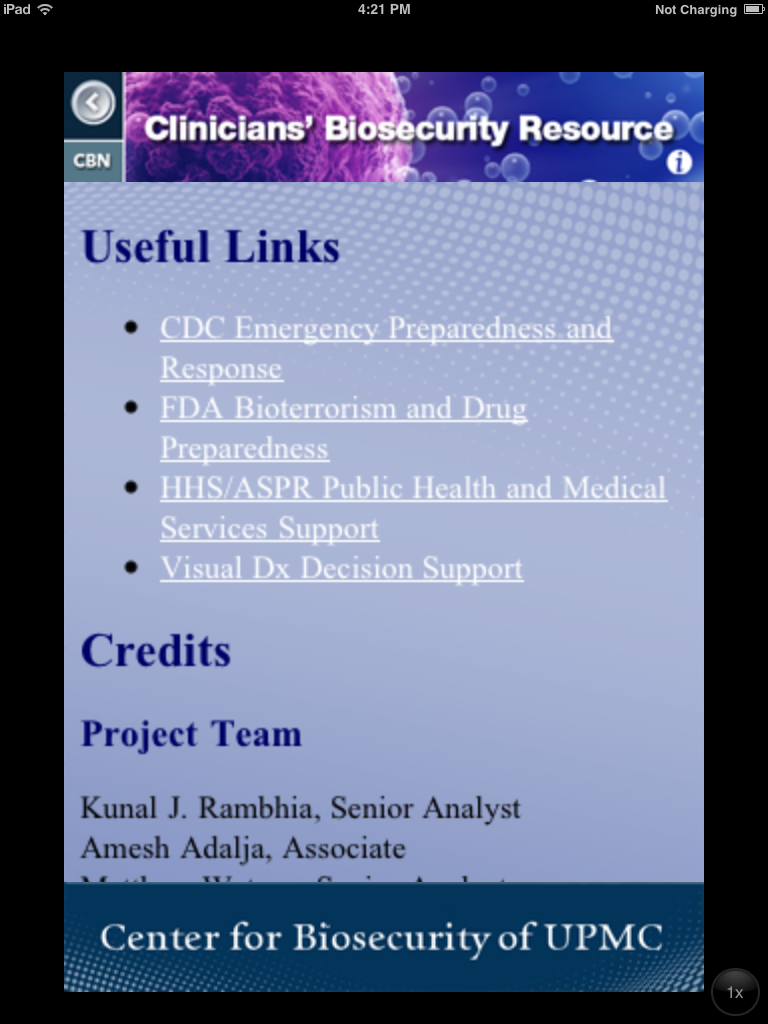
You can also access Clinicians Biosecurtiy News (CBN), published twice monthly, directly from the home screen. Clicking on the wrench icon on the CBN page provides an option to be reminded about CBR updates. The information icon (i) links to the 'about' page containing a disclaimer, developer credits and additional links for reference.

Typical bioagent page layout shown below (Anthrax page as example)


The Clinicians Biosecurity Reference (CBR) will be useful for emergency medical service professionals, nursing, as well as physicians. The layout/design and feature rich content take this app above and beyond. Navigation and user interface are simple and CBR runs smoothly on iPhone/iPad running iOS 5.0.1. The color scheme is much easier to read than BioAgent Facts. I highly recommend the CBR app.


Final Score 0-5: The CBR app gets a 4.5
Content: 4.5 Solid information from a trusted resource, easy to access and scan. External links to CDC and Biosecurity News add value. CBR app can go a long way being used as reference and learning tool. Dumping the Zombie section (as seen in BioAgents Facts) and adding sections for Naturally Occurring, PPE, and Post Exposure information is a major improvement.

Aesthetics/graphics: 4.0 Detailed graphics and color combinations that are easy on the eyes.

Ease of Use: 4.5 I found the tabs/buttons easy to navigate. Text is clear with pleasing color combinations. Stable on an iPhone/iPad (iOS 5.0.1) there is no clear support/FAQ available.

Wishlist for CBR:
Allow screens to rotate. This would be especially helpful for iPhone.
Enable gestures. Again, a big advantage for iPhone

January 19, 2012

Fight Fatigue, Reduce Error

The Joint Commission says fatigue risks patient care

The Joint Commission has issued a position warning  healthcare agencies to fight medical errors by fighting fatigue. Citing the link between health care worker fatigue and adverse patient care events, the Joint Commission revisited the issue of extended shifts and fatigue in a recent Sentinel Event Alert

According to the Joint Commission
Fatigue resulting from an inadequate amount of sleep or insufficient quality of sleep over an extended period can lead to a number of problems, including:
  • lapses in attention and inability to stay focused
  • reduced motivation
  • compromised problem solving
  • confusion
  • irritability
  • memory lapses
  • impaired communication
  • slowed or faulty information processing and judgment
  • diminished reaction time 
  • indifference and loss of empathy
 In 2007, the JC noted that strong evidence exists linking medical error, fatigue, and extended duration shifts. The findings indicate that exteded shift and night shift workers make 36% more serious preventable adverse errors than others and have a 61% more needlestick or sharps injuries. 

The take home message is that healthcare organizations need to assess the shift work/hours worked environment in their institutions for patient and provider safety. Key to reducing errors is to provide a culture of proactive safety. Staff should be able to express concerns about fatigue in the same way they would express concern if a colleague were impaired by intoxication.

Can these findings be applied to prehospital care? Certainly. While not be the norm in prehospital care, many services do work 24 hour shifts. It's far more common to find EMS professionals who may work far more than 24 hour shifts between multiple jobs. That is, work 12 or 16 hours at one EMS agency then go work another 8 or 12 at a part-time gig. Part-time work and other "off duty" work is not addressed by the JC in terms of healthcare providers. The fact remains that many EMS professionals do work more than one job. There is, of course, the dreaded "late call" that threatens to turn you 16 hour shift into much, much more.

Read The Joint Commission News Item/Action Alert: Click here
Direct Download Sentinel Event Alert: Click here

January 18, 2012

MJ 230 Your 2012 Preparedness To-Do List

 Welcome to 2012 and another year with Mitigation Journal. This weeks podcast is a summary of the challenges we face for planning and what we can do about it! Rather than give my predictions (as good as they are) I'd like to share a to-do list - a list of items that will help prepare for large scale events as well as the every day events.

Click on the player below to listen to Mitigation Journal podcast on this site...FREE!


Get the latest podcast delivered to you! Click here to subscribe...FREE
Get Mitigation Journal blog postings delivered to your email!
Support Mitigation Journal - click the donate button and help support this blog and podcast.

January 17, 2012

Less than lethal can still be deadly

Planning, decontamination, proactive response is needed. 

Click to subscribe to podcast
Riot control agents are considered “less-than-lethal” but they possess the potential to create multiple patients, decontamination issues, and respiratory hazards to the responders. Although usually not deadly, exposure to riot control agents stress the respiratory and cardiovascular systems. Like many other respiratory irritants they exacerbate a variety of respiratory and cardiovascular medical conditions and cause hypoxia resulting in critical patients.

Exposed persons with liquid product remaining on the skin or clothing is another concern. Certain types of chemical mace and pepper spray can cause skin irritation and burns. Ocular exposure can result in loss of sight.  Persons who remain contaminated with product also threaten secondary contamination by exposing responders to off-gassing. If exposed, contaminated persons are allowed to get into an ambulance or worse, into the hospital, without proper decontamination, the risk of significant secondary contamination and potentially hinder hospital efforts. Along the same theme is the risk of self-referring victims. People who have been exposed to a riot control (or any other irritant liquid or gas) may leave the scene prior to being decontaminated and triaged. Victims self referring to hospitals or urgent care centers pose a significant threat of secondary contamination. This risk is even greater when the local health care institutions are left out of the pubic service information loop. 

When encountering a situation involving riot control gases, I recommend the following:

  • Never assume the obvious threat is the only threat; other potentials should be considered. When someone tells you "its only pepper spray", don't believe them. Consider the potential of other agents such as cyanide, hydrogen sulfide, nitrates, chlorine, and phosgene can cause similar signs and symptoms to riot control agents.
  • Proper personal protective equipment and atmospheric monitoring devices must be used. This should include respiratory protection for responders. Canister masks or self contained breathing apparatus may be the appropriate level of protection. Atmospheric monitoring and non-invasive monitoring of patients should also be considered to help identify the agent. 
  • Anyone with reasonable exposure to the material should be assessed and decontaminated prior to leaving the scene. Little can be done for the internal exposure a gas. Those with exterior contamination, those who have residual agent on the skin or clothing, must undergo emergency mass decontamination prior to transport.
  • Local health care systems, including urgent care centers and walk-in care centers, must be informed of a chemical event occurring in their area. Health care systems must be able trigger their Emergency Operations Plans as soon as possible in order to prepare for the possibility of contaminated self-referring victims.
  • Fire and EMS resources should be deployed to appropriate health care locations in effort to assist with secondary decontamination efforts and management of contaminated self-referrals. 

Priority must be given to pre-planning at areas of critical infrastructure. Schools, hospitals, government buildings, and sporting venues are examples of soft targets that may also be considered critical infrastructure. Collaborative planning and training efforts between traditional and non-traditional responders (ie: EMS/Fire and school officials) will pay big dividends during crisis.

Response plans must be tested, practiced and revised. Tabletop exercises are a great low-cost way of doing this. Plans should be general in scope with annexes for specific threats. Planning for school events must include accounting for weather, media, dispersal of victims prior to arrival and site security. Don’t forget to build in communication with local hospitals.

Concern over too much school security has asserted that school security measures are a result of paranoia and not actual potential for an event. My stance is that schools are facilities of critical infrastructure by virtue of occupancy and potential impact of an attack/event. A natural disaster such as an earthquake or a Columbine-like attack will yield panic and disruption in any community. We cannot simply dismiss an event, any event, involving health care facilities, schools or other areas of critical infrastructure. They are soft targets and should be hardened and protected.

January 12, 2012

Four Drugs Cause Most Problems for Seniors

Free Podcast
A study published in the New England Journal of Medicine indicates that four medications cause the most adverse drug reactions resulting in hospitalization of seniors. According the CDC study and Medscape article, two thirds of the 100,000 hospitalizations of seniors each year are caused by Adverse Drug Reactions (ADR) involving anticoagulants and diabetic medications.

According to the CDC website, four medications, used alone or together, accounted for two–thirds of the emergency hospitalizations:
  • 33 percent, or 33,171 emergency hospitalizations, involved warfarin, a medication used to prevent blood clots.
  • 14 percent involved insulins.  Insulin injections are used to control blood sugar in people who have diabetes.
  • 13 percent involved antiplatelet drugs, such as aspirin or clopidogrel, which prevent platelets, or pieces of blood cells from clumping together to start a clot.
  • 11 percent involved diabetes medications that are taken by mouth, called oral hypoglycemic agents.
The Centers for Disease Control and Prevention define an Adverse Drug Events (ADE’s) as a serious health problem, and have published the following Key Facts on Medication Safety:
It is estimated that:
  • 82% of American adults take at least one medication and 29% take five or more [1];
  • 700,000 emergency department visits and 120,000 hospitalizations are due to ADEs annually [2];
  • $3.5 billion is spent on extra medical costs of ADEs annually [3];
  • At least 40% of costs of ambulatory (non-hospital settings) ADEs are estimated to be preventable [3].
The numbers of adverse drug events will likely grow due to:
  • Development of new medications
  • Discovery of new uses for older medications
  • Aging American population
  • Increase in the use of medications for disease prevention
  • Increased coverage for prescription medications

For more on this topic, visit the CDC Medication Safety Program.

January 10, 2012

2012 To-do List

No predictions! - Four actions for preparedness in the New Year


Click to subscribe
Like many of you, I like to make predictions around this time of year and, like many others, these predictions fall short of reality and are forgotten in a few weeks. We can do better! For 2012 I’m not making any predictions...I’m giving you a to-do list! A four point list of actions to take that will make you, your agency, and your community more prepared for naturally occurring disasters and intentional events. Take these items one at a time...and take your time with each. You’ll be surprised how fast you’ll be able to improve your preparedness.

Conduct a Hazard Vulnerability Assessment (HVA). Some might call this a hazard vulnerability inventory (HVI). The Hazard Vulnerability Assessment (HVA) examines the occurrence or potential occurrence of a given hazard(s) in your community. The impact of the hazard(s) should be measured in terms of impact or threat to life and health, physical damage, and damage/disruption to critical infrastructure.  Your HVA should also account for economic and social factors that will increase vulnerability to any given hazard. The Hazard Vulnerability Assessment is not a prediction but an analysis designed to answer questions or “what if” scenarios.
If you’ve done your Hazard Vulnerability Assessment, great. Then add a review and validation of that assessment to your To-do List for 2012.

Work on your Pre Incident Plans. Pre planning can be a never ending chore. Hazards change, threats increase and decrease, and capabilities may also change. The general basis for pre planning emergency and disaster situations is to maintain a certain level of preparedness and interoperability. Your pre plans should include regional and local response to biological events, both naturally occurring and intentional acts. Consider incorporating regional plans into your local pre planning as well. I’d also suggest a review of any plans to receive assets and resources during crisis situations. One such area to consider is a plan to receive assets from the Strategic National Stockpile or other supply. Consider including or updating pre plans that are specific for public information, explosive events, and active shooter events. Click here for more on Pre Incident Planning.

Define your Target Hazards. A target hazard can be defined as a location or area that poses an increased level of interest or attraction to an intentional event. Target hazards can also be identified as those areas or locations that have increased life hazard or secondary risk associated with them. Locations of critical infrastructure should be on your target hazard list as well. Critical infrastructure includes any location or service that, if lost or compromised, would limit or stop your ability to provide service. Power generation, water treatment, hospitals, public service should all be considered areas of critical infrastructure. When defining your target hazards, don’t limit yourself to those locations within your community. You should consider the high value/critical infrastructure locations in neighboring jurisdictions as well. Doing so will increase your preparation and effectiveness during mutual aid responses.

Combine your Hazard Vulnerability Assessment (HVA), Pre Incident Plans, and Target Hazard Identification into training. Use the Exercise Design Process to build realistic training opportunities. Don’t be afraid to start small or call on an outside expert to help construct your training activities. Build on what you do now...start with small seminars to summarize the training objectives and raise awareness to the situation, then conduct a tabletop exercise to add an element of stress yet provide a safe training environment. After you’ve built your training base, move on to a series of drills that test one or two elements of your plan. You can then move on to conducting functional exercises testing large plans in realistic field scenarios. For 5 tips to improve your exercise design click here.

December 29, 2011

Cold Weather Emergency Incident Rehab - PrePlanning and Incident Action Planning for EIR

This is final segment of our four part series on the topic of Cold Weather Emergency Incident Rehabilitation (EIR). In this segment we'll discuss the importance of planning and pre planning for EIR. We also discuss the role of the incident safety officer and Incident Action Planning that includes EIR. Joining me for this series is Dr. Jeremy Cushman, Medical Director for Monroe County, NY.

In this series we've reviewed the need for rehab, special logistical considerations in cold weather EIR operations, and the importance of "pre-habilitation" and remaining fit for activity during cold weather.  Changing weather conditions and the use of Incident Action Planning in relation to rehabilitation operations are covered in this final segment. 

Cold Weather Emergency Incident Rehabilitation was produced for emergency responders off all disciplines. Health care professionals who may treat responders in the hospital environment  will also benefit from this background information. For more on cold weather emergencies, click here.


Click the player below for the audio from all four parts in this series.

December 27, 2011

Cold Weather Emergency Incident Rehab - "Pre-Habilitation"

This is part three of a four part series on the topic of Emergency Incident Rehabilitation. In this segment we'll discuss the importance of "pre-hab" and physical fitness. Joining me for this series is Dr. Jeremy Cushman, Medical Director for Monroe County, NY.

In part one we reviewed the need for rehab, in part two we discussed special logistical considerations.  Changing weather conditions and the use of Incident Action Planning in relation to rehabilitation operations are covered in part four. 

Cold Weather Emergency Incident Rehabilitation was produced for emergency responders off all disciplines. Health care professionals who may treat responders in the hospital environment  will also benefit from this background information. For more on cold weather emergencies, click here.


;


Click the player below for complete audio version.

December 22, 2011

Cold Weather Emergency Incident Rehab - Logistical Considerations

This is part two of a four part series on the topic of Emergency Incident Rehabilitation. In this segment we address the special logistical considerations for establishing Emergency Incident Rehabilitation in cold weather. Joining me for this series is Dr. Jeremy Cushman, Medical Director for Monroe County, NY.

In part one we discussed the need for rehabilitation. In part three we'll cover the importance of "Pre-Hab" and physical fitness. Changing weather conditions and the use of Incident Action Planning in relation to rehabilitation operations are covered in part four.

Cold Weather Emergency Incident Rehabilitation was produced for emergency responders off all disciplines. Health care professionals who may treat responders in the hospital environment  will also benefit from this background information. For more on cold weather emergencies, click here.


Click the player below for complete audio version.


December 20, 2011

Cold Weather Emergency Incident Rehabilitation - The Need for Rehab

This is part one of a four part series on the topic of Emergency Incident Rehabilitation. In this segment we'll discuss the need for rehab at all situations - truly a "sector for all seasons". Joining me for this series is Dr. Jeremy Cushman, Medical Director for Monroe County, NY.

In part two we'll discuss special logistical considerations, part three covers the importance of "Pre-Hab" and physical fitness. Changing weather conditions and the use of Incident Action Planning in relation to rehabilitation operations are covered in part four. 

Cold Weather Emergency Incident Rehabilitation was produced for emergency responders off all disciplines. Health care professionals who may treat responders in the hospital environment  will also benefit from this background information. For more on cold weather emergencies, click here.


l

Click the player below for complete audio version.

December 6, 2011

Traditional lectures find new life in "new media"

Co-posted on the GVNA blog

Using multi-media and internet strategies to reach today's health care and EM students.

I stumbled on this topic while reading one of my favorite blogs, Life in the Fast Lane. The post, Peer Reviewed Lectures, really caught  my attention. As a semi-pro blogger and podcast host, I truly appreciate (and honestly believe in) the incredible value of multiple instructional strategies and web-based interaction. Traditional topics will find new life when a "new media" twist is applied. All you have to do is embrace the New Media delivery!

This video from Academic Emergency Medicine outlines criteria for peer reviewed lectures.


Peer Reviewed Lectures from Academic Emergency Medicine on Vimeo.

Continuing education becomes cutting edge and lecture content can be taken at-will or on demand to satisfy specific needs. This New Media approach also reaches out (and grabs on to) the Millennial Generation as well as those who want that convenience offered by this media. In the video below, Danielle Hart, MD (Hennepin County Medical Center Department of Emergency Medicine) outlines the learning style differences between various generations and how this non-traditional instructional tool bridges the educational gap. 

December 2, 2011

What will the next AED be?

The following anonymous comment on Paramedic Future (Mitigation Journal July, 2009)

Anonymous wrote:
Thank you for your post. Examining your argument that technology will eventually replace the need for the paramedic I find some flaws. I feel like your argument is similar to saying why teach long division now that we have calculators. However, the computer diagnosis on the 12-lead is horribly unreliable. I don't know how many 911 calls I've made for "ST wave abnormality" on perfectly good 12-leads. As providers and educators we need to push for solid physical assessment skills and diagnostic skills. The ability to read and interpret a 12-lead is still a paramount paramedic skill. I currently work one of my jobs at a teaching hospital and while moving a trauma patient a physician shouted, "the patient is in v-tach!" the physician reached for the defibrillator without question as one of the medics explained that the alarm on the monitor was merely artifact from movement. If we've learned anything it is that common sense isn't common at all. We need to continue to educate and trust the interpretation of skilled providers over technology.
My response:

I don't believe that technology will replace paramedics. In fact:
"...technology can't consider the patient as a whole and put all the assessment pieces together like a skilled paramedic can." 
In the original piece I bring up the possibility that reliance on technology may not be a good thing:
"...Like any other technology, once we become accustomed to it, we become dependent on it...In the case of EKG's I'm afraid we'll eventually decide we don't need to teach reading them any longer...what will we do when technology fails?"
The point is that technology may put appropriate diagnostic tools and treatment possibilities in the hands of more responders and may make it possible to speed treatment in the field, improved triage of limited (and costly) hospital specialty care services, and pave the way for advanced practice paramedics.

In the 1950's, CPR was a physician-only skill. Defibrillation was a paramedic skill until the 1980's. Today, both CPR and automated external defibrillators make it possible for almost any member of the public to improve survival from cardiac arrest. We have to think forward to what the next "AED" will be.

December 1, 2011

Unwanted contacts on your phone

E. Coli on the list of nasty bugs in your contact list!

Think about this the next time you put your phone to your face -
A study published in October, 2011, found that 92% of cellular phones are contaminated with nasty bacteria...including E. Coli. The cause of the contamination is people using their phones while in the restroom. Texting while toileting has been identified as a contributing factor. 

According to research conducted by the London School of Hygiene & Tropical Medicine and Queen Mary, University of London:
  • 92% of phones had bacteria on them.
  • 82% of hands had bacteria on them.
  • 16% of hands and 16% of phones had E. coli bacteria.
How do you decontaminate your phone/handheld device after use in the clinical environment?

Read the full article from Medscape here.

November 29, 2011

7 Health Care Preparedness things you need to know

7  things you need to know...and why you need to know them


#1. Understand the broad scope of threats and trends in your community. Know what your local responders and emergency planners working on and what your community plans call for.

Why? Best reason why is to be a better prepared citizen, parent, [nurse] [medic]. You’ll be able to carry out your duties (at any level) during times of crisis and add to the success of the response.

#2. Know your internal emergency plans. Know your role within the plan and how crisis situations  change the way you do what you do every day. Know what triggers your emergency plans to be put into action and when to shift from your standard of care to sufficiency of care. Consider what will change when you have to shelter in place or evacuate.
Why? There may not be time to look things up during a crisis situation and the event will most likely change quickly. Being familiar with your plans ahead of time cuts down on reaction time and contributes to good outcomes. That is, lives saved...yours and your [patients] [citizens] If you’re

#3 Have a basic understanding of the Hospital Incident Command System.

Why? You will have to work within the HICS system during any crisis and you might be put into a lead role at some point. A basic awareness of the HICS and how to carry out the various functional positions within it will go a long way to success in the small scale and large scale of the event.

#4. Know the special resources of your institution and those around you.

Why? Knowing what specialties services are available gives you an idea of how certain cases will be triage into your system. You may also get an idea of the type of patients you can expect when a specialty hospital (burn unit, trauma or cardiac center) is over-run or has to evacuate. conversely, you can get a head of the decision making for sending your patients out to other appropriate facilities if you know their capabilities.

#5. Know how to prepare yourself and your family for community emergencies...and do it.

 Why? The best way to prepare a community for disasters is to prepare the citizens. Well prepared citizens  and communities lead to improved outcomes in disaster situations. On the professional side, having a prepared family means that we can continue to go to work and do our jobs better. Keeping staff coming back to work in times of crisis is a major concern. The best way to improve the numbers of people coming back to work is to help them prepare their families to shelter or evacuate as needed during crisis.

#6. Recognize incident indicators, signs/symptoms and heralding events that foretell a problem. In other words, pay attention to what's going on around you...even when you're off duty.

Why? You situational awareness may be all that stands between you and harm. Someone has to be the first to recognize danger signs...don't wait for someone else to tell you there's a problem...

#7. Get better accuainted with your Personal Protective Equipment. Even the stuff you use every day

Why? Some research has suggested that personal protective equipment may not be utilized properly and that annual training is not enough. Without regular and on-going practice, the PPE we have may not be used, or worse, used improperly.

November 28, 2011

MJ: 224 Emergency Alert System test -Part two

Click for direct download
FEMA conducted a never before attempted Nation wide test of the Emergency Alert System on November 9, 2011. The test included television, radio, cable, and satellite carriers. Despite the effort on the part of FEMA, there are many who suggest this was more like a pop quiz than a test.

This week we complete our discussion with Matt and Jamie talking about the success of the test, role of social media, and the continued need for the Emergency Alert System. We even get into the CDC's Zombie Apocalypse preparedness program. 


    Click the player below to listen now

November 22, 2011

Mitigation Journal - 6 years later

Thank You for six years of support.


We're celebrating six years of Mitigation Journal blogging and podcasting. When I clicked "publish" for the first time back in November, 2005, I couldn't have predicted how important this blog would become to so many readers and listeners. Our growth has been tremendous.

From blog to podcast to video to lecture...delivery of material has grown. We've published over 600 blog posts and dozens of videos. More than 6000 people visit Mitigation Journal DOT ORG every month. I've met so many people through Mitigation Journal and I've lost count of how many places I've been asked to visit - to give a talk or consult on a project. I've met so many emergency service professionals through the use of social media. I've had the opportunity to review plans, provide opinions, and teach.

What's next? I can't begin to predict. The only thing I can say for sure is that Mitigation Journal will continue to provide unique perspectives on civil preparedness and emergency response. I don't like the mainstream way of emergency management thinking and would rather stay off the beaten(down) path.

Through blogging, podcasting, social media, and independent reporting, we'll continue to examine the limitless topics of preparedness and response for civilians, traditional rescuers and non-traditional responders.

We'll be reporting on current events, conducting case study, providing original material sprinkled with commentary. Mitigation Journal will cover everything from routine incidents to local disaster and national crisis. Professional responders and concerned citizens will gain valuable insight into preparedness and emergency response.

With real world experience and insight, Mitigation Journal will be there helping you prepare for whatever challenges your role in preparedness demand...health care, emergency medical service, fire department, public health preparedness...Mitigation Journal will cover it all.

With your help. With your continued support.

November 18, 2011

Reaction to Cold

Reaction to Cold: How the body responds


Vasoconstriction.
Tachycardia.
Tachypnea.
Brochospasm.
Dehydration. 

They are the major effects of cold that are the root of all other problems. These five body changes are the building blocks of system failure caused by cold environmental conditions. They all stress the healthy body.

Cold conditions do not have to be extreme to cause problems. Even mild decreases in temperature are enough to trigger those five major effects of cold can cause increased heat losses through radiation and conduction. Heat losses can increase 25 to 30 times when a body is in contact with a cold or wet surface.

Any condition or disease that involves vasoconstriction, respiratory or neurological impairment places a person at increased risk during exposure to cold. In general, increased cold exposure risk increases with:
  • age < 1
  • Circulatory, vascular or neurological disease
  • Raynaud's Phenomenon
  • Alcohol, tobacco, caffeine, or energy drink use
  • Trauma or Hypoglycemia
  • Prior cold injury
Better health means better performance in cold environments. Exposure to cold decreases mental capacity with increased risk of injury, accidents and errors

While often considered during the hot summer month, dehydration is a major threat during cold periods. Evaporation, sometimes referred to as insensible losses, increases with cold atmospheric conditions. Respiration moisture losses account results in large amount of fluid loss through evaporation. These respiratory/evaporation losses  increases dramatically in cold environments as the moisture in exhaled breath increases. Dehydration is more prevalent with excessive use of caffeine or alcohol. Prolonged exposure to cold and dehydration are important variables to evaluate as both increase risk for hypothermia.

Environmental exposure to cold is also linked to decreased mental capacity. Reduced mental endurance has been shown to increase the risk of errors and accidents. Responders should be taking this into account when operating in cold environmental conditions for any period of time.  Further, the physical discomfort associated with exposure to cold, even for brief periods, may contribute to decreased mental alertness.

Additionally, there is an increased risk of physical injury while operating in a cold environment. Joints and muscles become stiff and strength decreases. These factors lead to sprains and strains and muscular micro-trauma as well as acute injury. These effects can be seen in the well-conditioned person just as easily as in those who are not in good physical condition.

Factors in remaining warm include maintaining good food/nutrition status, adequate fluid and hydration and maintaining reasonable physical fitness.

November 14, 2011

MJ: 223 Emergency Alert System Test

Click for direct download
FEMA conducted a never before attempted Nation wide test of the Emergency Alert System on November 9, 2011. The test included television, radio, cable, and satellite carriers. Despite the effort on the part of FEMA, there are many who suggest this was more like a pop quiz than a test.

This week on Mitigaiton Journal Podcast, Matt, Jamie and I discuss several important topics related to this test and the status of the Emergency Alert System. In this two part discussion we'll ask:
  • was the test a success?
  • what is the impact of omitting social media from the test?
  • what should the role of social media be in emergency alerting?
  • do we need the emergency alert System anymore?
    Click the player below to listen now

November 10, 2011

Zombies, the Public Health Mascot?

Zombies, the Public Health Mascot?

The Centers for Disease Control and Prevention (CDC) began a Zombie Preparedness initiative with the goal of engaging the public on preparedness. Obviously not just for a "Zombie Apocalypse", the information projected by the CDC's Office of Public Health Preparedness is useful in real-world disaster situations. Reaching a diverse audience is what this campaign is all about. According to the CDC website:
"If you are generally well equipped to deal with a zombie apocalypse you will be prepared for a hurricane, pandemic, earthquake, or terrorist attack." Dr. Ali Khan, Director
Are Zombies the enduring icon public health wants to be remembered by?
I appreciate the efforts of the CDC and believe they've reached a major milestone in pubic health awareness. Will the Zombie Apocalypses continue to be effective? What the CDC has done is to copy  what traditional responders have been doing for years: public education through an iconic mascot. The fire service has Sparky the fire dog and law enforcement has McGruff, the Crime Dog...and the CDC/Public Health has Zombies. Sparky has his own site as does McGruff. The CDC Zombies have an enhanced web presence with a graphic novel, apps, YouTube and webpage widgets. Each embrace popular culture with an appropriate message.

Is the Zombie audience going to get the message?
The fire service and law enforcement continue to put uniformed responders into the schools and at public events to reinforce the messages of Sparky and McGruff. Real world people teaching age-appropriate information. The Zombie Apocalypse initiative is web and social media savvy but it is also static. You have go out and look for it. Traditional public safety puts educators in contact with at-risk populations to deliver and reinforce the message.

Will the Zombie image be a motivating factor in getting a kit, making a plan, and being informed?

Putting an icon to a message is a good idea. I'm not sure that the Zombie image is exactly what the CDC and public health want their enduring icon to be. A large issue is the identity of public health. Is it time to consider public health part of emergency preparedness or public safety? I think so. With that in mind, is the public health preparedness message better delivered via a partnership with traditional response groups? Should police and fire educators take on public health awareness task?

One solution may be a partnership between the CDC and the National Fire Protection Association to deliver a joint public health preparedness message. That message (including the Zombies) could be delivered by local uniformed responders, personnel from the local hospital or health department during fire prevention week. I advocate for public health preparedness to become part of Fire Prevention Week activities (maybe Fire Protection Week needs a name change?)


November 8, 2011

Get Bio-Event Ready or Die

     ...or at least get sick. 3 Things to do today to prevent even that!


 Three things to do to Be Ready for a natural or intentional biological event:
  1. Train your people on infection control and personal protective equipment (PPE) more than once a year. This is the time to develop good habits for regular cleaning and disinfection of our vehicles and workplaces. Several studies have pointed out that practice with masks...getting proper fit and knowing how to put them on properly...is as important as annual fit-testing.
  2. Promote the safety and health of responders and their families. That means getting appropriate vaccine or other medications available for your personnel and at-risk family. Identify those who can't get vaccinated or take medications and take steps to isolate them from infection. Numerous self-report surveys have concluded that one key to keeping your personnel coming to work in a biological event is provide for the safely of the family.
  3. Prepare a Can't Go Home Plan. Stock you stations and facilities with food, water, hygiene products and ready additional bunk areas to keep personnel in-house during extended operational periods.

November 3, 2011

Report claims North Korea has Smallpox

Smallpox may be in the biologic hands of North Korea


A recent posting by the Global Security Newswire caught my eye. The headline reads something about North Korea and expanded WMD production. Normally this would get a "so what else is new" response from me but, a quick scan of the piece kept my mouse from clicking away. According to the October 27 article, South Korea claims...
"The military authorities understand that among the 13 types of fungus body of biological agents that North Korea currently has, five types -- including anthrax bacterium, botulinum, and smallpox -- can actually be used as weapons."
 Excuse me, did you say smallpox? I was led to believe that smallpox samples resided in only to repositories on Earth. The World Health Organization (WHO) believes this to be the case as well and since 1986 the has been arguing about the destruction of these stockpiles of Smallpox. Destruction of these virus reserves would mean the removal of the treat of this virus on our planet. Smallpox virus samples were due for destruction but received a stay of execution over the summer of 2011. (learn more on Smallpox stay of execution click here)

Does North Korea (or any other nation) actually has smallpox virus? Can it be or has it been weaponized? South Korea seems to think so and has undertaken an unprecedented bio-preparedness initiative. Good for them. The bad news is that, once Smallpox is let out of the freezer, it will not stay in Korea. One case of Smallpox any place on Earth will ignite a global health crisis. A crisis we are not ready to face. As we saw during the H1N1/Swine Flu episode, our health care system may not be "there" yet when it comes to being ready for a major biologic event.

In the United States we stopped routine vaccination against Smallpox in the 1970's and immunity of those vaccinated prior to that is unclear. There have been some promising data suggesting those vaccinated will still have protection but nothing conclusive. Those born after we stopped vaccination would have no immunity. (click here for more on Smallpox vaccine) Despite the vaccine and the virus, there are steps you can take to protect yourself and your workforce. (Be bio-event ready click here)

There are several things to remember about Smallpox as a bio weapon, chief among them is the estimate that one person with the disease can infect about 20 others. To that we should mention that Smallpox has an approximate fatality rate of 30% and is spread by aerosol transmission. (read my 5 points to remember click here)

A good place to start your refresher class on Smallpox is with a review of biologic tabletop exercises such as Dark Winter and Atlantic Storm. (Click here for more on DW/AS)


November 1, 2011

Biologic Worst Case: Smallpox Terrorism

 Exercise Highlights Biologic Devastation - Comparing Dark Winter and Atlantic Storm
Terrorist attacks using biological agents are potentially deadly beyond imagination. How would we respond to a devastating Smallpox attack?

That is the exactly the scenario tested by the Dark Winter exercise (2001) and Atlantic Storm (2005).


Exercise similarities, important differences


Both Dark Winter and Atlantic Storm focused on government leadership and their ability to manage issues in public health, medical capabilities, diplomacy, domestic response, and critical infrastructure. Both exercises were well developed and planned...they did, however, reach different results. Despite commonalities in scenario and biological agent there are striking differences between the two exercises.

In order to compare the two exercises I studied the documents, video and layout of the scenarios themselves. Of course, some study of the Smallpox virus itself was helpful.


Comparison of Assumptions


Dark Winter focused on the United States as the only target in a “worst-case” scenario while Atlantic Storm targeted the international community with “best-case” circumstances. 

Although both scenarios simulated the use of smallpox as the agent with similar methods of dissemination, there were concerning differences in the projected infection rates, death rates, and person-to-person transmission potential. Smallpox deaths in the Dark Winter scenario were projected at thirty percent while Atlantic Storm used a twenty-five percent. Atlantic Storm also assumed that there was residual immunity among the affected population with 300 million doses of vaccine available. Dark Winter was somewhat less optimistic, assuming a stockpile of 15.4 million doses of vaccine would be available from the Centers for Disease Control and Prevention. Reality is present with vaccine assumptions as the scenario accounted for up to twenty percent of stockpile loss due to contamination or improper use.


Dark Winter hypothesized that 1gram of Smallpox could generate 100 infections when aerosolized resulting in 3000 first generation cases from 30 grams of virus. There is no mention of virus quantity in Atlantic Storm, however, both scenarios disseminate the virus via an aerosolizing device under similar conditions. Dark Winter used 1:10 transmission rate (every one person with smallpox could infect ten others) as compared to Atlantic Storms rate of only a 1:3 ratio. Atlantic Storm also anticipated 1: 0.25 for second to third generation while no mention was made in the Dark Winter scenario of second to third generation transmission. Dark Winter planners integrated herd immunity of twenty percent into the scenario which was not accounted for in Atlantic Storm. The lack of herd immunity in the later exercise may be reflect doubt that any immunity exists among the currently vaccinated population.

I found the following excerpt from the Dark Winter scenario an interesting commentary on person-to-person transmission rate.
“…Given the low level of herd immunity to smallpox and the high likelihood of delayed diagnosis and public health intervention, the authors of this exercise used a 1:10 transmission rate for Dark Winter and judged that an exercise that used a lower rate of transmission would be unreasonably optimistic, might result in false planning assumptions, and, therefore, would be irresponsible. The authors of this exercise believe that a 1:10 transmission rate for a smallpox outbreak prior to public-health intervention may, in fact, be a conservative estimate, given that factors that continue to precipitate the emergence and reemergence of naturally occurring infectious diseases (e.g., the globalization of travel and trade, urban crowding, and deteriorating public health infrastructure) [26, 27] can be expected to exacerbate the transmission rate for smallpox in a bioterrorism event…”
Atlantic Storm best-case scenario planned for adequate disease control, compliance with public health “social distancing” (quarantine/isolation), available vaccine, higher herd immunity, residual protection granted by prior vaccination, and lower transmission rates. The wide range of transmission rates between the two exercises may account for the differences in total number of smallpox cases and deaths. Dark Winters worst-case predicted 1,000,000 deaths with 3,000,000 infections while the Atlantic Storm exercise predicted 660,000 cases and approximately 495,000 deaths.


Learn more about Smallpox from the CDC- click here

October 27, 2011

Tabletop Exercises Predict Biologic Disaster

What we can learn from Dark Winter and Atlantic Storm

Everyone remembers Hurricane Katrina. Did you know that about a year before Katrina there was another devastating hurricane? Just about a year before Katrina hit the Gulf Coast, Hurricane Pam ripped through causing the levee system to fail, flooding New Orleans, and causing destruction on nearly a life for life, dollar for dollar par with Katrina. The storm was Hurricane Pam and you didn’t read about this storm in the paper or see it on television. Why doesn't anyone remember Hurricane Pam? You don’t remember Pam because it never actually happened...Hurricane Pam was a tabletop exercise (TTX) that predicted with eerie accuracy what would happen if a major hurricane scored a direct hit on the Gulf Coast. The point is that we can learn a lot from our own exercises if we listen. In this post I’m suggesting we learn the lessons from two biologic event tabletop exercises...

In the setting of a naturally occurring or intentional biologic attack how will countries manage shortages of medicine, vaccines, and medical supplies? What mechanisms will be used to control or halt the spread of disease? How will local and national leaders balance their responsibilities to their own citizens with their responsibilities to the international community?

These are the questions we should be asking ourselves and these are the issues addressed by two tabletop exercises Dark Winter and Atlantic Storm.

Click the player below for staged media footage used in Dark Winter.

Watch Dark Winter Pretext for TOPOFF/CCMRF/CBRNE Martial Law Drills in Educational & How-To | View More Free Videos Online at Veoh.com
In June of 2001, the Johns Hopkins Center for Civilian Biodefense Strategies along with the Center for Strategic and International Studies, the Analytic Services Institute for Homeland Defense held a senior-level tabletop exercise that simulated the effects of a covert biological attack on the United States. The dissemination of highly contagious smallpox as an act of terrorism became known as the “Dark Winter” scenario. This one-of-a-kind TTx examined the ability of senior-level policy makers to face the challenges of a bioterrorist attack with outbreaks of highly contagious diseases.


A few years later, in January, 2005, a similar exercise took place. This time among the international leadership community, known as Atlantic Storm, this TTx continued on a larger scale from the Dark Winter exercise. Atlantic Storm simulated the heads of state and senior international governmental leaders attempting to manage a simultaneous bioterror attack. The attack was centered on Istanbul, Frankfurt, Warsaw, Rotterdam, New York, and Los Angeles with Smallpox as the weapon.

Already know it all? Think again. Atlantic Storm verbalizes many of the issues discussed in recent studies as well as historic preparedness problems. An excellent real-life example, Atlantic Storm is also a high quality tabletop exercise, complete with PDF user guides and downloadable documents, Atlantic Storm provides an outstanding example of power a tabletop exercise (TTX) can bring to the planning and training process.

A review of Dark Winter and Atlantic Storm is a useful tool for traditional and non-traditional responders. Take an hour and view the presentation, review the documentation. To view Atlantic Storm; go to: http://www.atlantic-storm.org/flash/index-b.html and turn up you speakers!