The EMS News network is sadly reporting the deaths of two Paramedics in British Columbia, Canada.
As reported in the Vancouver Sun: “two paramedics -- Kim Weitzel, 35, and Shawn Currier, 21 responded for some type of mine accident - When a mining contractor mysteriously disappeared at Teck Cominco's Sullivan mine, a second man was sent to look for him.”
He found the contractor's body.
The man led two other rescuers to the body.
All three died.
Early unconfirmed reports indicate the possibility of an oxygen deficient atmosphere and exposure to hydrogen sulfide contributing to the deaths of the contractor and the Paramedics.
Know your district, know your limitations.
EMS personnel typically do not have respiratory protection to enter an immediately dangerous to life/health (IDLH) atmosphere. The best, and in many cases only protection, for EMS personnel is to have situational awareness and understand the potential hazards of any given response area. Complacency kills.
EMS has a vital role in rescue operations. EMS services that are not associated with fire/rescue services may respond to find situations to be different than reported. Failing to recognize the hazards and taking appropriate self-protective measures can be devastating. When arriving to find a previously unreported hazard, the EMS crew first on scene can provide vital information and should call for appropriate response.
Our thoughts and prayers are with those in B.C. Canada.
May 19, 2006

This Plan is Your Plan; This Plan is My Plan.
We’ve been looking down the barrel of a loaded “pandemic gun” all winter. We’ve been meaning to do something abut biological preparedness since West Nile Virus, Anthrax, and SARS (what I have no idea). So, here comes spring and were guided ever so gently by the media away from flu (avian or otherwise) and pointed towards gas prices, immigration, and the ‘who’s who’ list of ex-Bush team members. Although not without good reason and some value, we’ve forgotten about the “pandemic gun” or maybe just because the weather is warm here we figure that gun is no longer loaded.
Its spring; Do You Know Where Your Plans Are?
Just because we’re out of the typical flu season is no rationale whatsoever to put planning and training for such an event on the back burner. Numerous updates have surfaced in the last few weeks. Perhaps the most striking (if only in volume) is the Pandemic Influenza Implementation Plan published by the Department of Homeland Security in early May, 2006. The object of this plan is to outline the governments effort to prepare for pandemic influenza and identify the critical roles of state and local authorities, private sector, and communities to address the threat of a pandemic. I’ll be conducting a review of the DHS plan shortly. You may recall the Department of Health and Human Services issued their own Pandemic Plan in November, 2005. Please see Mitigation Journal archives for November 2005 for my review of the HHS plan.
I’ve been asked a number of questions recently pertaining to planning, preparedness and response capabilities. There is no easy way to address many of the questions. The sad fact is; that despite effort and dollars; most plans in most jurisdictions fall short of reality. The overtone seems to be that the health care community and public health are going in one direction and traditional response groups are not going anywhere at all when it comes to planning for a biological event.
Each of the plans I’ve reviewed share a number of pitfalls. These plans assume:
1. The ability to communicate will not be disrupted and accurate/factual information will flow
2. Power and transportation will be readily available
3. Personnel will be healthy enough and willing to report to work
4. Civil obedience will be maintained both in the community and at health care facilities
5. Patients will be able to be evacuated to neighboring facilities or regions.
In addition, these plans do not mention the fact that every-day emergencies will continue to come to hospitals expecting treatment.
Let’s take a look at each one of these at its own context.
Communications.
Each plan assumes that there’s going to be the ability to communicate. And further, the ability to communicate will be undisturbed throughout any given event regardless of the length or scope of that event. It is reality however; the day-to-day communication is difficult to maintain even under ideal conditions. Case studies of numerous large scale events in history of all services indicate the communications will be among the first piece of infrastructure to be compromised. Further, the ability to rely on information from any given point must be questioned. When communication systems have failed or are compromised alternate means of communication will spring up; and it is these alternate means of communications that will lend a false sense of communications security and ultimately yield unreliable and inaccurate information on which decisions will be made.
Emergency plans also indicate their reliance on power and transportation with little or no mention of alternate means of supplying electricity, light, heat, or a means of moving people from place to place. The reliance on public energy and public transportation are critical weak link in the disaster and emergency planning process. Power in transportation are linked together in the disaster planning setting; in any given instance if we have and reliable and hardened power infrastructure capable of producing climate control, light, and maintaining critical operations in a given facility we can reasonably assume that facility will remain habitable and functional during crisis. If the power supply is threatened or lost we will no longer be capable of sheltering in place throughout the crisis in decisions will have to be made concerning evacuations and alternative sheltering. Should the need arise to evacuate a given facility, especially a Healthcare facility such as nursing home or hospital, there will be our reliance on emergency medical service transportation to effect such an evacuation. EMS transportation vehicles may or may not be available in such a situation. One must understand that all traditional response groups, including emergency medical services, will have their resources stretched to capacity and beyond. Air and ground transportation units will be subject to the same problems of fuel, power, and communications disruptions as fixed facilities. Alternate means for power supplies and shelter in-place needs must be addressed by fixed facilities in addition to evacuation contingency planning.
Another fatal flaw in emergency planning is the assumption that personnel will in fact report to work. This consideration must be taken without regard to the status of roadways and transportation. A survey study conducted by Columbia University in September, 2005 demonstrates possibility of personnel, who are otherwise unaffected by crisis, refusing to report to work. In this study, health care workers were asked to indicate if they would be able to report for work or willing to report for work in the event of a mass casualty incident. 81% said that they would be able to go to work if there was an environmental disaster, yet only 69% said they would be able to go to work during a small pox epidemic. The study goes on to note that the willingness to report for work would only be 48% of health care workers during a SARS outbreak. Further, only 57% of health care workers would return to work in the setting of a radiological event. The fallacy in this stage of planning is to assume that Healthcare workers who have a perceived obligation to respond will, in fact report to work. Numerous sources have noted that the willingness to report for work in any situation may be impacted by concerns for the safety of the responder’s family. It is important for employers of public and private organizations to understand that the family care can be as vital as responder care. Workers fears will impact their willingness to work and administrators and company leaders must talk to their workers about these concerns regarding exposure and contamination and reassure them by planning to assure family and dependent safety. An example of such contingency planning would be the setting of avian flu or H5N1 pandemic. It is estimated in such a situation that nearly 30 to 40% of the American workforce would become stricken or ill and unable to report for work of any kind. And that percentage the number of persons engaged in critical infrastructure duties such as police, fire department, EMS, or other critical infrastructure positions failing to report for work and any given crisis situation can then be expected to be magnified.
In the above mentioned settings simple failures in the supply chain for routine maintenance can become catastrophic.
Another important point to consider is that of the lack of surge capacity in the concept of ripple effect deaths. Surge capacity is a specter of imagination as many Healthcare systems operate at or above capacity every-day. Just as the traditional response groups will continue to respond to the routine calls for service during a large scale event, routine requests for routine medical emergencies will continue to arrive at local hospitals. Lacking surge capacity will almost certainly cause some of these otherwise routine patients to destabilize and become critical or fatal. This can add to the death toll of any large scale event and further destabilize community infrastructure. Much attention has been given to triage in the appropriate use of medical resources such as ventilators. Triage of such medical procedures and devices is also unrealistic; consider that just a short time ago the health care community could not come to consensus on the triage of flu vaccine during a shortage and without the pressure of an actual event going on.
This Plan is Your Plan; This Plan is My Plan. Not.
Despite the fact that numerous of urgency service agencies and Healthcare systems have spent countless hours and dollars on the planning process few if any of these plans integrate with each other. There is little if any continuity between traditional response groups and Healthcare systems or any other community infrastructure for that matter. Failure of any agency or service to adopt or even recognize the existence of the national incident management system or NIMS will be the cornerstone of failure during a large scale event. Scant few services, either public or private, address, and planning needs or participate in any level of joint training. This unfortunate situation is perhaps the least expensive and easiest to implement, yet remains ignored.
What do we do now?
There are no clear-cut answers in any of these situations. However failure to acknowledge that such shortcomings exist in the planning process may themselves the largest obstacle to overcome. The setting of a biological vent weatherman made intentional or natural cannot be compared to acts of terrorism the American public has become familiar with. Any naturally occurring biologic event or intentional act of biological terrorism will force our change in perspective.
The good news is we have been dealing with biological events for quite some time. We have come to no and rely upon basic medical personnel protective equipment and procedures such as hand washing and respiratory etiquette. These protective measures which we employ every day will serve us well in the setting of a biologic event.
Never Mind Osama, Here's the Aryan Nation
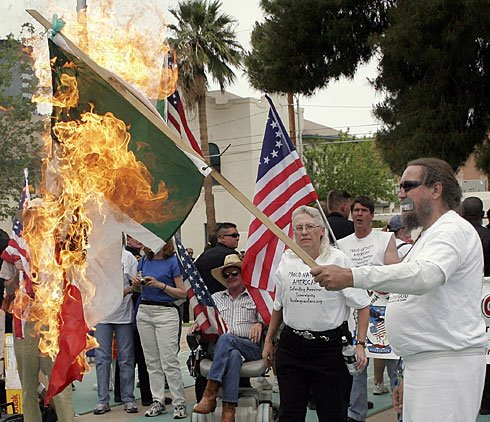
I’ve been sitting on the sidelines for a bit longer than planned. My expected weekly publish date of April 26 has long gone by. Despite the word from some sources that my opinions are not well received; I continue to be asked when the Journal will be updated. There is no holding back since I've recently been called the “Super Wal-Mart of conspiracy theory and apocalyptic thinking”. Remember: My Blog; My Rule. (I still don't care about APA or MLA style. Stop telling me about it!) So, here's my view on a few topics...
No way in hell are we going to oust all or even a meaningful number of illegal immigrants, even if we logistically could, to what political and social end? Huge implications for U.S. diplomatic relations with South America (read: oil) FOR THE RECORD: I have not made a stance on deportation of illegal immigrants. I have a daily personal and professional struggle with this issue; and therefore will try to look objectively. Hold the hate mail, please.
Guest worker program = stop gap measure; polarization of government and society on this issue will grow exponentially (can you say Race War?)This will be compounded by a few factors: decline of the middle class and evaporation of health care. Sure; foreign aid, gas prices, and any other hurricane will play a role, too. Will there come a time when the only stable employment is held by "undocumented workers"?
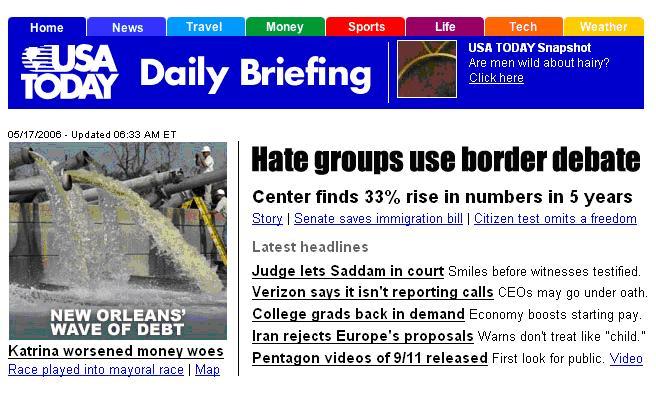
Terrorism: forget about Osama et. al. I predict the social and economical implications of all this will put a torch to the domestic groups that have been so quiet in the last decade or so. Look for white supremacy groups, KKK, militia, anti-gov movements and the like to become vocal and active! (Can you imagine David Duke getting prime-time coverage?) Read the USA Today Story: http://www.usatoday.com/news/nation/2006-05-16-hate-immigration_x.htm
No way in hell are we going to oust all or even a meaningful number of illegal immigrants, even if we logistically could, to what political and social end? Huge implications for U.S. diplomatic relations with South America (read: oil) FOR THE RECORD: I have not made a stance on deportation of illegal immigrants. I have a daily personal and professional struggle with this issue; and therefore will try to look objectively. Hold the hate mail, please.
Guest worker program = stop gap measure; polarization of government and society on this issue will grow exponentially (can you say Race War?)This will be compounded by a few factors: decline of the middle class and evaporation of health care. Sure; foreign aid, gas prices, and any other hurricane will play a role, too. Will there come a time when the only stable employment is held by "undocumented workers"?
Terrorism: forget about Osama et. al. I predict the social and economical implications of all this will put a torch to the domestic groups that have been so quiet in the last decade or so. Look for white supremacy groups, KKK, militia, anti-gov movements and the like to become vocal and active! (Can you imagine David Duke getting prime-time coverage?) Read the USA Today Story: http://www.usatoday.com/news/nation/2006-05-16-hate-immigration_x.htm
March 5, 2006
Port Security


I’d like to thank everyone who took a minute to participate in the Port Security study. The graphics represent totally unscientific results as collected over the past several days.
After seeing the results, I’d like to hear from you. What conclusions, if any, can we draw? Comments will be posted as they come in!
February 23, 2006
Port Security Issues
Like many of you, I have my doubts about port security. My concerns have been heightened by the recent disclosure that a company owned by the Untied Arab Emirates (UAE) have been given management authority over several major United States ports.
I do, however, wish to keep and open mind and to that end am doing some research on the topic. There will be a opinion posted here soon. In the meantime, I'd like to hear from you. Please take the Port Security Servey at http://www.opinionpower.com/Surveys/587035284.html
If you have trouble with the survey, please email me directly. Feel free to forward the survey as well as Mitigation Journal to others who may be interested.
I do, however, wish to keep and open mind and to that end am doing some research on the topic. There will be a opinion posted here soon. In the meantime, I'd like to hear from you. Please take the Port Security Servey at http://www.opinionpower.com/Surveys/587035284.html
If you have trouble with the survey, please email me directly. Feel free to forward the survey as well as Mitigation Journal to others who may be interested.
February 20, 2006
Tabletop Exercises for Effective Training
Do you remember Hurricane Pam? Despite having dumped 20 inches of rain with sustained winds of 120 mph and causing a storm surge that crumbled levees in New Orleans, virtually no one remembers Hurricane Pam despite the unfortunate fact that Pam has an eerie resemblance to Hurricane Katrina. How about the Dark Winter of 2002? That Dark Winter resulted in over three-million cases of smallpox and caused at least one-million deaths as the disease spread around the globe.
If you’ve ever wondered how your agency would respond under the most difficult of situations a tabletop exercise (TTX) is for you!
Chances are you’ve never heard of either of these disasters. You haven’t heard of them because they never happened…Hurricane Pam and Dark Winter were tabletop exercises designed to promote emergency and disaster preparedness.
If you’ve ever wondered how your agency would respond under the most difficult of situations, with new leadership, working with a recently written or updated response plan, a tabletop exercise (TTX) is for you!
A tabletop exercise simulates an emergency situation in an informal, stress-free environment. The participants can be either people on a decision-making level, veterans of the organization, or new members, who gather around a table to discuss general problems and procedures in the context of an emergency scenario. The focus is on training and familiarization with roles, procedures, or responsibilities. No plan? No tools? No problem! A TTX is also a great way to build a response plan based on input from the exercise and can be accomplished with some basic preparation (just like a lesson plan) and without any special equipment.
The tabletop is largely a discussion guided by a facilitator (or sometimes two facilitators who share responsibilities). Its purpose is to solve problems as a group. There are no simulators and no attempts to arrange elaborate facilities or communications. One or two evaluators may be selected to observe proceedings and progress toward the objectives.
The success of a tabletop exercise is determined by feedback from participants and the impact this feedback has on the evaluation and revision of policies, plans, and procedures. In many respects, a tabletop exercise is like a problem-solving or brainstorming session where problems are tackled one at a time and talked through without stress.
Problems and Messages
A tabletop is not tightly structured, so problem statements can be handled in various ways. The facilitator or controller directs the flow of the TTX by adjusting time frames and messages. Messages or injects as they are often referred to, are statements used by the facilitator to simulate an event within the scenario, add a problem or situation, or put the TTX back on track as needed. A majority of messages or injects are created in advance and are built upon the scenario itself.
The purpose of tabletop exercises is usually resolving problems or making plans as a group. That means going after real solutions not superficialities.
The facilitator can verbally present general problems, which are then discussed one at a time by the group. Problems can be verbally addressed to individuals first and then opened to the group. Written detailed events (problems) and related discussion questions can be given to individuals to answer from the perspective of their own organization and role, and then discussed in the group.
Another approach is to deliver pre-scripted messages to players. The facilitator presents them, one at a time, to individual participants. The group then discusses the issues raised by the message, using the EOP or other operating plan for guidance. The group determines what, if any, additional information is needed and requests that information. They may take some action if appropriate.
Occasionally, players receiving messages handle them individually, making a decision for the organization they represent. Players then work together, seeking out information and coordinating decisions with each other.
Some facilitators like to combine approaches, beginning the exercise with general problems directed to key individuals and then passing out messages one at a time to the other players.
Group Problem Solving
The purpose of tabletop exercises is usually resolving problems or making plans as a group. That means going after real solutions not superficialities.
Some facilitators make the mistake of trying to move too fast through the scenario, believing that they have to meet all of the objectives and get through all of the messages. However, that is not a good approach if nothing gets settled.
Remember: If you spend all the time on one big problem, maintain interest among players, and reach consensus, then the tabletop is a success! Push the players past superficial solutions. A few carefully chosen, open-ended questions can keep the discussion going to its logical conclusion.
Designing a TTX is Simple!
There are eight simple steps you can use to design a TTX:
- Assess your needs
- Define the scope
- Write a statement of purpose
- Define TTX objectives
- Compose a narrative
- Write major and detailed messages
- List expected actions
- Prepare messages
Applying the Design Steps
The Narrative: The tabletop narrative is sometimes short. It is nearly always given to the players in printed form, although it can be presented on TV or radio. When the purpose of the tabletop is to discuss general responses, the narrative can be presented in parts, with a discussion of problems after each part.
Events: The events should be closely related to the objectives of the exercise. Most tabletop exercises require only a few major or detailed events, which then can easily be turned into problem statements.
Expected actions: A list of expected actions is useful for developing both problem statements and messages. It is always important to be clear about what you want people to do. However, in a tabletop, sometimes the “expected action” will be a discussion that will eventually result in consensus or ideas for change.
Messages: A tabletop can succeed with just a few carefully written messages or problem statements. As always, messages should be closely tied to objectives and should be planned to give all participants the opportunity to take part.
The messages might relate to a large problem (almost like an announcement of a major event) or a smaller problem, depending on the purpose of the exercise. Usually they are directed to a single person or organization, although others may be invited to join in the discussion.
Ex-FEMA Chief Makes the Case for the All-Hazards Approach
Michael Brown was the head of the Federal Emergency Management Agency. Was; that is, in the past. You’ll recall seeing him in front of cameras from CNN, NBC, ABC, FOX, CBS pleading his case about how “we (FEMA) are doing everything we can” to rescue the City of New Orleans. With the continual video footage of New Orleans residents stranded on rooftops, stories of emergency services breaking down, and chaos at the Superdome; we sat and wondered how this all got that bad.
And in the middle of it all Michael Brown was sent home to D.C. with his tail firmly between his legs. A few days later he resigned as FEMA’s Director.
The Congressional hearings and fact-finding started back in December of 2005 and Michael Brown came out swinging. His words should be the wake-up call for dumping the wasteland “terrorism preparedness” and “WMD training” have become. These terms and many others like them indicate the national focus of Homeland Security (another moronic term) and inappropriately shifted our focus away from big-picture preparedness; the All-Hazards Approach.
You see, as Brown stated in his testimony “if we’d confirmed that a terrorist had blown up the levee, then everybody would have jumped all over it trying to do everything they could” we are waiting for a terrorist to bring destruction to us. We’ve forgotten the Rule of Outcomes that states that certain commonalities exist among emergencies of small and large-scale and that those commonalities can be successfully planned for, trained for, and mitigated if the all-hazards approach is taken.
Brown suggests what I believe to be true; the current fixation on anti-terrorism played a major role in the outcome of Hurricane Katrina. Our over concentration on terrorism has made preparedness for disasters and emergencies other than terrorist events has made preparing for natural disasters, power failures, storms, floods, earthquakes, and more to become the forgotten stepchild of the Department of Homeland Security. The same terrorism blinded approach will continue to hamper efforts in warning, rescue, response, mitigation, and recovery of future events as well.
The Department of Homeland Security has done exactly what their name implies…worked on security. Unfortunately, security is only one piece of the all-hazards puzzle. Security is not synonymous with preparedness. The culture and mindset of a security force cannot embrace the inherent needs of preparing for emergencies and disasters whatever the cause.
Hurricane Katrina killed nearly 2000 people and displaced hundreds of thousands of others. The storm caused physical damage with estimates in the tens of billions. Katrina’s visit nearly destroyed the City of New Orleans. A chemical or radiological attack on New Orleans could easily result in similar outcomes and response needs. Would there have been thousands stranded in New Orleans waiting for help after a chemical attack? Would there have been chaos and shortages at shelters after a nuclear event in New Orleans? Generically speaking, why would we mitigate differently?
And in the middle of it all Michael Brown was sent home to D.C. with his tail firmly between his legs. A few days later he resigned as FEMA’s Director.
The Congressional hearings and fact-finding started back in December of 2005 and Michael Brown came out swinging. His words should be the wake-up call for dumping the wasteland “terrorism preparedness” and “WMD training” have become. These terms and many others like them indicate the national focus of Homeland Security (another moronic term) and inappropriately shifted our focus away from big-picture preparedness; the All-Hazards Approach.
You see, as Brown stated in his testimony “if we’d confirmed that a terrorist had blown up the levee, then everybody would have jumped all over it trying to do everything they could” we are waiting for a terrorist to bring destruction to us. We’ve forgotten the Rule of Outcomes that states that certain commonalities exist among emergencies of small and large-scale and that those commonalities can be successfully planned for, trained for, and mitigated if the all-hazards approach is taken.
Brown suggests what I believe to be true; the current fixation on anti-terrorism played a major role in the outcome of Hurricane Katrina. Our over concentration on terrorism has made preparedness for disasters and emergencies other than terrorist events has made preparing for natural disasters, power failures, storms, floods, earthquakes, and more to become the forgotten stepchild of the Department of Homeland Security. The same terrorism blinded approach will continue to hamper efforts in warning, rescue, response, mitigation, and recovery of future events as well.
The Department of Homeland Security has done exactly what their name implies…worked on security. Unfortunately, security is only one piece of the all-hazards puzzle. Security is not synonymous with preparedness. The culture and mindset of a security force cannot embrace the inherent needs of preparing for emergencies and disasters whatever the cause.
Hurricane Katrina killed nearly 2000 people and displaced hundreds of thousands of others. The storm caused physical damage with estimates in the tens of billions. Katrina’s visit nearly destroyed the City of New Orleans. A chemical or radiological attack on New Orleans could easily result in similar outcomes and response needs. Would there have been thousands stranded in New Orleans waiting for help after a chemical attack? Would there have been chaos and shortages at shelters after a nuclear event in New Orleans? Generically speaking, why would we mitigate differently?
January 15, 2006
National Emergency Medicine Report Card

Mediocre: average; ordinary. That’s New York. That’s New York health care according to the American College of Emergency Physicians, anyway.
The American College of Emergency Physicians (ACEP) has recently released the National Report Card on the State of Emergency Medicine – Evaluating the Environment of Emergency Care Systems State by State. In this 129 page document, ACEP rated each state on access to emergency care, quality and patient safety, public health and injury prevention, and medical liability. An overall grade was calculated for each state as well as for the Nation as a whole.
“The results are sobering” says ACEP. “The National health care system is in serious condition, with many states in critical condition” the report says. ACEP concluded the emergency medicine system in the United Sates [as a whole] rates a C-…just above “D”. As for individual states; no state scored either an A or an F. I sense political correction here! After all, if some state were to receive an A; there would be no room for improvement. Conversely, can you imagine the fallout should a state rate an F? After reading the report I speculate that some state(s) in fact should have rated an F, but for fear of litigation, bad press, or whatever ACEP did not assign the grade. Perhaps the ACEP version of no child left behind…everyone passes. But don’t let my cynicism fool you.
The American College of Emergency Physicians (ACEP) has recently released the National Report Card on the State of Emergency Medicine – Evaluating the Environment of Emergency Care Systems State by State. In this 129 page document, ACEP rated each state on access to emergency care, quality and patient safety, public health and injury prevention, and medical liability. An overall grade was calculated for each state as well as for the Nation as a whole.
“The results are sobering” says ACEP. “The National health care system is in serious condition, with many states in critical condition” the report says. ACEP concluded the emergency medicine system in the United Sates [as a whole] rates a C-…just above “D”. As for individual states; no state scored either an A or an F. I sense political correction here! After all, if some state were to receive an A; there would be no room for improvement. Conversely, can you imagine the fallout should a state rate an F? After reading the report I speculate that some state(s) in fact should have rated an F, but for fear of litigation, bad press, or whatever ACEP did not assign the grade. Perhaps the ACEP version of no child left behind…everyone passes. But don’t let my cynicism fool you.
Take a look at the grading criteria:
· States that reached at least 80% of the top state score received an A
· States that reached at least 70% of the top state score received a B
· States that reached at least 50% of the top state score received an C
· States that reached at least 30% of the top state score received an D
· States that fell below 30% of the top state score received an F
· States that reached at least 80% of the top state score received an A
· States that reached at least 70% of the top state score received a B
· States that reached at least 50% of the top state score received an C
· States that reached at least 30% of the top state score received an D
· States that fell below 30% of the top state score received an F
Let’s get back to New York.
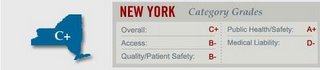
New York State scored an overall grade of C+. Great, we’re just above the middle…mediocre. Access to emergency care rated a B-, quality and patient safety B-; under 70% for both.
Can anyone please tell me; since when can you score 50% on anything and get a C? In New York, EMT’s have to achieve a minimum of 70% to pass a written EMT or paramedic exam.
If I were in charge of NYS health care, I’d take away the PlayStation!
Public health and injury prevention leads the pack with a whopping A+…that is, a little better than an 80%. And bringing up the rear; Medical Liability Environment: D-.
The grades only tell half the story. New York ranked 49th for number of emergency departments per 1 million people and 43rd in percentage of population with access to enhanced 9-1-1 services. Yet, New York ranked near the top in annual Medicare fee-for-service (4th), annual Medicaid cost per person younger than 65 (7th), and annual per capita expenditure on hospital care (3rd).
There is little wonder why insurance costs in NYS are out of control. Insurance costs in Western NY are expected to jump between 12% and 16% in 2006
(for more information see the post: Spring Loaded in the Stupid Position http://mitigationjournal.blogspot.com/2005_11_01_mitigationjournal_archive.html)
The report cites overcrowding, medical liability concerns, poor access to care, and get this; inability to respond to public health emergencies or terrorist attacks as major shortfalls. The report attributed its findings to increased demands placed on the emergency medical system, and on budget cuts, which have lead to a steady decline in critical-care beds. The report noted that “the number of emergency departments has decreased by 14 percent since 1993. . .and hospitals are operating far fewer inpatient beds than they did a decade ago.” The report also found that there is a general association between the wealth of a state and emergency care, and a correlation between population density and a state’s overall grade.
FEMA, health care, disastrous events…is anyone adding this up?
Read the report: http://my.acep.org/site/DocServer/2006-NationalReportCard.pdf?docID=221
The report cites overcrowding, medical liability concerns, poor access to care, and get this; inability to respond to public health emergencies or terrorist attacks as major shortfalls. The report attributed its findings to increased demands placed on the emergency medical system, and on budget cuts, which have lead to a steady decline in critical-care beds. The report noted that “the number of emergency departments has decreased by 14 percent since 1993. . .and hospitals are operating far fewer inpatient beds than they did a decade ago.” The report also found that there is a general association between the wealth of a state and emergency care, and a correlation between population density and a state’s overall grade.
FEMA, health care, disastrous events…is anyone adding this up?
Read the report: http://my.acep.org/site/DocServer/2006-NationalReportCard.pdf?docID=221
January 2, 2006
Get Rid of that Customer!
Here is my New Years resolution for 2006. This woke me up from a sound sleep the other night so, I have to just put this one out there and wait to hear what you think.
Get rid of the term “customer”. All-in-all the term customer is not a bad way to describe the people we serve as it embodies thoughts and accompanying behaviors that are most often positives in public service. Webster’s defines customer as a patron, clientele, or consumer. Rather than simply defining the term, let’s examine what a customer is…what actions do they take? What choices do they make?
The fact is that a customer or consumer makes a decision as to what services or goods they wish to consume along with the time of use and consumption. A majority of emergency service “consumers” don’t make those choices. They call when the need arises. In daily life, the consumer may also choose with whom they do business. Again, the majority of the folks calling 9-1-1 have no choice about who is going to show up to take care of them or put out their fire. So, in our “this is a business” mentality, the term customer is the first to go.
Let’s replace customer with citizen. A citizen deserves our care and attention. “Citizen” implies earned respect and comes with certain expectations. We’re not working behind the counter at Burger King and the citizens we serve are not customers! They are citizens of our communities.
The term “productivity” is another useless business term I won’t be using (or tolerating from others) in 2006. I just can’t stand it, the term as applied to emergency service lacks meaningful definition…even by the limp and leaderless that uses it!
The term “productivity” is another useless business term I won’t be using (or tolerating from others) in 2006. I just can’t stand it, the term as applied to emergency service lacks meaningful definition…even by the limp and leaderless that uses it!
I have had enough with supposed leaders spouting off about emergency services being a Business! Yes, I know the administration and management of any public service organization must be conducted in a business-like and professional manner. I also understand that the use of public funds such as tax dollars, require a level of justification and prudence. Agencies such as commercial ambulances certainly have to be managed as the business they are. But I’m not talking about commercial or for-profit services here. I’m strictly addressing tax-based organizations. The point that’s getting under my skin is that some leaders in public service agencies are starting to use the “this is a business” mentality and associated terminology and taking it way too seriously.
It seems that we have traded brothers for employees, leaders for managers, and a culture of family in service for a culture of corporate corruption and disposable people. Can you imagine the day when firefighters come to work as if it were “just a job”? Public emergency service is a calling, not just a job! Can we expect that our would-be leaders that are now managers in the “this is a business” mentality will continue to adopt other traits of the big business world? Perhaps we’ll be seen as more productive if they were to adopt a KODAK or ENRON mentality? Think of it…the disloyalty, dishonesty, and the corporate CEO corruption! Is this where emergency service leadership is heading?
Let’s get rid of the customer and go back to serving the citizen. Let’s understand that how a firefighter or EMT represents themselves in the public eye and what they are capable of doing is productive.
December 28, 2005
Clinical Decision Making in Patient Assessment

Part One: LOCATE the Patient
This is the first installment of a three-part series on patient asse3ssment. Part one will introduce LOCATE system as a guide to help the EMS provider on assessing the patient, the scene, and as a decision making aid. Part two will discuss the not-so-obvious details of physical exam finding, and in part three; we’ll discuss assessment aids such as the Cincinnati Stroke Scale, Pediatric Assessment Triangle, and trauma triage schemes.
It seems simple enough; before you can provide treatment and transportation you have to find the person in need of your service. Actually finding the patient is only part of the job. Providers of emergency medical service (EMS) at all levels must prepare themselves prior to reaching the scene or patient for a variety of potential actions and outcomes. Waiting to arrive on-scene to develop a care plan or mental review of the potential scenarios places both provider and patient at a disadvantage. The fire services use the process of pre-incident planning and size-up to prepare firefighters for potential needs or dangers of any given situation. Pre-incident planning can be used to anticipate additional resources and special needs of a situation. Emergency medical services can and should do the same.
EMS and fire service text are filled with acronyms that have become part of daily conversation. Acronyms are memory aids that range from the simple ABCDE’s that remind us of the basics of patient assessment to SLUDGE as a memory jog for organo-phosphate exposure symptoms. In this installment we will introduce the acronym LOCATE as a means of assessing not only the patient, but the scene and patient needs as a whole.
Location. In the real estate business location is everything and so it is for EMS. What do we as EMS providers need to know about the location we are responding to in order to accomplish our goals and objectives? What can we tell about a situation before we enter the environment? Let’s consider the following questions:
What type of occupancy are we at?
How well do you know your response district?
What geographical special needs or special hazards have to be considered?
Respocnes to group homes, rehabilitation centers, and senior living centers demand special attention by the responder. The structure itself can yield important clues as to the special needs of those inside and impact your options. Calls to medical facilities and clinics add yet another dimension to your response such as dealing with medical professionals and therapy-in-progress. The key to situational assessment is to anticipate, not stereotype.
Obstacles such as ramps, lifts and the presence of customized vehicles should prepare you for the special needs of the person inside the location and warn you about special hazards of getting in and out with all your equipment (including your lumbar spine) safe and intact. Commercial buildings and public places offer some challenges that are not as obvious. Small elevators may prevent your crew from arriving or returning together. Who will stay with the patient and what vital equipment will you keep with you? In public places on-lookers can become an obstacle. Patient dignity and privacy in the public venue must be addressed differently than in a private residence in effort to preserve the comfort and cooperation of the patient during treatment. The responder must also consider the presence of security video surveillance, camera phones, and other digital recorders. Responders must anticipate that a majority of the public owns some type of digital recording device and consider the impact these devices may have on privacy and care.
Conditions such as post medical conditions are a routine part of EMS assessment. Now consider the living conditions you find the patient in. By being observant to living conditions; EMS providers have a unique opportunity not available to others in the health care system. Situational awareness can yield important clues that must be relayed and addressed by the health care system. The GEMS diamond used in Geriatric Education for Emergency Medical Services is a good example. The EMS provider must again ask themselves a number of questions:
Are the patient, the family, and the care givers able to carry our daily activities?
Has there been a change in how the patient cares for themselves? If so, is the cause of the change medical in nature, such as in the setting of CVA/TIA, or social a aspect such as the loss of a spouse or other supporting person?
Family support or lack thereof plays an important role in every situation. The EMS provider must not only find medications but assess if the patient is physically and mentally able to take them.
The presence or absence of Accessories is closely related to conditions and considers physical items.
Is the patient using the cane or walker? If not, is lack of use or lack of the device a cause of falls and injuries?
Has the patients’ ability to use such a device changed and are they no longer able to use their accessories?
Other accessories that should be assessed include home oxygen units, air-powered nebulizers, ventilators, hospital beds and lifts, commodes, and orthopedic devices. The presence of basic medical supplies can also indicate the level of care a person should receive on a daily basis. The presence of many other medical accessories may also indicate the need for another and arguably more important need; and educated caregiver in the home. There is no substitute for the love and compassion provided by a family in the home-care situation. EMS providers must harness the educated family or caregiver as a precious piece of the assessment puzzle. Failure to do so can result in the loss of valuable information, inaccurate diagnosis and treatment, and poor public relations.
Treatment is what you do for the patient. Your assessment should lead to a working diagnosis list and guide your treatment. Treatment provided by previous EMS responses and discharge paperwork from previous emergency department visits is also important. We all have a list of frequent users of our services but, do we communicate what we’ve done to help these people? We shouldn’t have to reinvent treatment each time we see a previously treated patient. Multiple requests for “lift assists” for example, may indicate subtle changes in patient condition or change in social status indicating the need for augmented services. The key is to anticipate, not stereotype.
Evaluate the need for Education and Extra help. The EMS provider has the ability to see the patient in their surroundings as they are every day. EMS should also be knowledgeable of patient education topics pertaining to safety and well-being, social programs, and signs of abuse. Consider the following questions:
Are you aware of the signs of elder, child, or domestic abuse? If so, what are your reporting requirements?
Are you aware of the community programs that may be of benefit to those in crisis?
Being able to provide information on social programs and domestic support are vital for the EMS provider.
Evaluation must begin prior to response. Weather conditions and time of day must also play a role here. Other events; natural disasters and intentional events locally, nationally, and internationally must also be taken into account. It is here that you have the opportunity to help any member of the public prepare for crisis…even those that are not medically related.
Summary
The ability to assess the scene and the patient before you arrive is a skill learned with experience. The acronym LOCATE is:
Location
Obstacles
Conditions
Accessories
Treatment
Evaluate, Educate, Extra help
Use LOCATE to guide your patient care plans on-route, on-scene, and after care to build your assessment of the patient as whole. Pre-planning and size-up are important aspects of patient care; if you LOCATE each patient you will be better able to keep these points and patient care in focus.
December 24, 2005
Clinical Decision Making
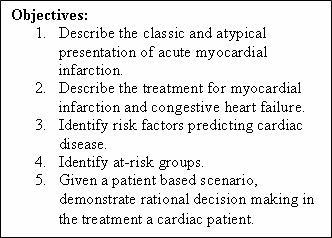
The following is an excerpt from my Clinical Decision Making lecture series on cardiac emergencies. In this selection I focus on the “nuts and bolts” of chest pain and congestive heart failure. The continuation module; SYNCOPE: The EMS Fatal Masquerade will be published shortly.
Previous Clinical Decision Making lectures include LOCATE the Patient and The Dead: Clinical Decision Making in Cardiac Arrest. The latter are under revision and will be re-issued in January 2006.
Cardiac Events and Congestive Heart Failure
It comes as no surprise to the experienced EMT or paramedic that a majority of patients requesting emergency medical service have complaints of cardiac or respiratory nature. These complaints are often categorized from the acute complaint of chest pain, syncope (or near-syncope), or short of breath to cardiac arrest. Most often, when someone calls EMS, there is little question as to what the problem is…especially when the chief complaint is stated as above. Difficulties arise when the chief complaint is less evident and patient presentation is less than acute as in the case of the “weak and dizzy”, the elder person who is just “not acting normal”, and the cold/flu patient.
The difficulty is for the provider to differentiate between the two and treat appropriately. Making the call between myocardial infarction, congestive heart failure (CHF), chronic obstructive pulmonary disease (COPD), and cold/flu can be difficult in any setting. Mistaking the patient in CHF for one who has respiratory infection can be deadly. Equally so, is the patient with syncope or near-syncope that claims to be “fine” now. Conducting a through assessment is critical to discovering what type of condition the patient may have, formulating a differential diagnosis list, and making treatment/transport decisions.
Chest Pain
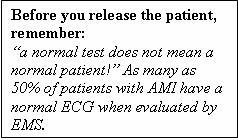
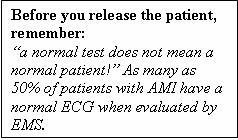
Discovering the etiology or cause of chest pain can be difficult for EMS providers mainly because the pain is described in vague terms. Patients with cardiac related pain or discomfort often have visceral pain. A patient with visceral pain may complain that the symptoms are located in a general area and intermittent yet, worsen with time. They also note the nature of the pain as dull, aching, or numbness. By contrast, somatic pain is able to be localized to a specific area by the patient. This somatic pain may change with movement or position of the patient. A word of caution is due here; any pain in the chest, either somatic or visceral, must be taken seriously as a potential cardiac event. Fundamental BLS care including oxygen and evaluation by advanced life support is necessary.
In addition to the quality (visceral or somatic) of pain, the location of chest pain is also non-diagnostic. That is; the location of pain often will not directly relate to the origin of the pain. Many groups of patients may not experience the “classic” symptoms of chest pain, shortness of breath (SOB), arm/neck pain, nausea, diaphoresis, and the like. Diabetics, elderly, and post-menopausal women may experience altered or atypical presentation of a cardiac event. Persons who are chronic drug abusers may also not report textbook symptoms. In any case, decreased severity or absence of pain does not equate to a non-life threatening condition in the setting of chest pain. In addition to the classic signs and symptoms of cardiac events, be on the lookout for the following list in addition to the classic symptoms:
· Weakness and fatigue
· Pressure in the chest
· Palpitations, or racing heart
· SOB or dypsnea…even if mild
· Painful digestion, dydpepsia
· Neck, back and epigastric pain
· Symptoms that wake the patient from sleep or keep them from sleeping
· Any change in mental status, syncope or near-syncope…even if the patient “is fine now”.
Any one of the above should indicate potential for a cardiac event, with or without chest pain. With these complaints, the EMT must consider acute myocardial infraction (AMI), angina (stable and unstable), cardiac dysrhythmias, and pulmonary embolism. Again, solid BLS care should be initiated as well as ALS assessment and transport.
Congestive Heart Failure
Congestive heart failure or CHF is a situation when one or both (univentricular and biventricular) of the heart ventricles is no longer capable of maintaining discharge capacity of fluid returning to the heart. The results may be seen in the form of any number of symptoms depending upon what side of the heart is failing.
This is a good time to remember some basic physiology of the heart. The right side of the heart is under low pressure in relation to the left heart as it receives blood from the body (pre-load) and is responsible for pumping into the pulmonary system for gas exchange. With this in mind, one can visualize that any factor the restricts or diminishes the right heart ability to push blood will result in a backup of fluid into the systemic circulation; the liver and dependant areas for example. This situation is compounded by inability to get blood to the pulmonary system for oxygenation. When this occurs, not only is oxygenation impaired with resulting hypoxemia, but the left ventricle (and cardiac output) also becomes challenged. Simply put, the left heart cannot pump required volume if that volume is not delivered (no pre-load, no after-load). These situations can arise from AMI, valve failure (tricuspid, pulmonary, or both), and fluid depletion. Paradoxically, the most common cause of right heart failure is left heart failure a.k.a Cor Pulmonale.
A similar situation occurs if the left or high pressure side of the heart is involved. The left heart can be thought of as the high pressure side and is responsible for ejecting blood to the body via the aortic valve and the aorta. This is known as after-load. Anything that reduces the left ventricles efficiency can technically cause left heart failure. Think of it this way:
If volume entering the left atria are insufficient, there will be decreased discharge
If the mitral (bicuspid) valve fails either by stenosis or regurgitation (narrowing or allowing backward flow), the left ventricle (LV) either cannot fill or losses discharge pressure and volume back to the left atria.
If the aortic valve is stenosed or narrowed, the LV must work harder to discharge the needed volume and pressure.
If the LV is damaged from AMI and not able to accommodate the preload being sent
These bullets indicate that LV failure can come from any number of causes: AMI, valve failure, and prolonged high systemic pressures (high blood pressure). Regardless of the cause, the results of decreased cardiac output and backup into the pulmonary system (high pulmonary pressures and pulmonary edema) may be seen.
Common Sense Stuff
Heart failure is basically a theory of backed-up fluid that accumulates behind the chamber (or side) of the heart that is affected. Patients with severe left ventricular infarction often exhibit symptoms of respiratory distress and hypoxia as a result of impaired pumping ability (decreased after load) and pulmonary edema as the existing pre load backs up behind the left ventricle. The increased pulmonary pressure is passed on the right ventricle and may eventually cause it to become impaired. In the setting of right heart failure, either resulting from left heart failure or right ventricular AMI, pre load decreases (remember: the left heart can’t pump out what it doesn’t get) and fluid backs up behind the right heart and into the systemic circulation. This fluid accumulation becomes visible as ankle edema, edema in dependant areas of the body, and liver engorgement (congestive hepatomegaly).
Is It Acute or Chronic?
We may find any number of symptoms of heart failure presented to the EMS provider. Unfortunately, the early or mild symptoms may be confused for cold/flu symptoms…a dangerous clinical assessment mistake! The symptoms depend not only on the side of the heart affected, but the rate at which pathology develops. Look at it this way; if a patient suffers a massive MI, arrhythmia such as rapid atrial fibrillation/ventricular tachycardia, or valve failure, drastic reduction of cardiac output and/or pulmonary edema may follow. If the patient goes on to survive any of the above or if conditions progress over a long period of time, the patient may compensate. Compensatory mechanisms may include enlargement of the heart, and many form of neurohormonal changes. In this case frequency of EMS contact and ED visits often increased.
November 13, 2005
Review of HHS Pandemic Flu Plan
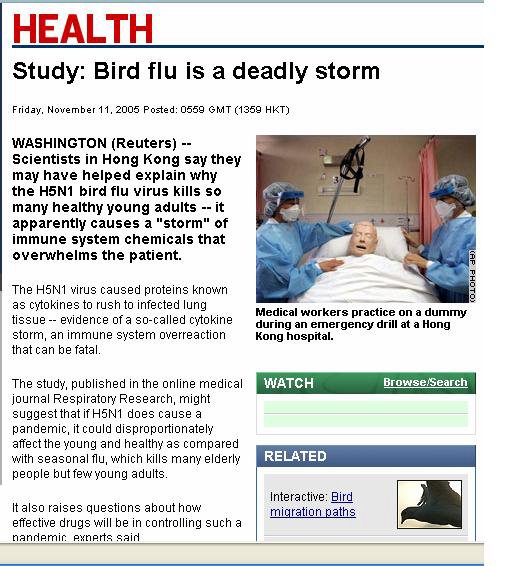
I've wallowed in the 394 pages of the HHS Pandemic Influenza Plan for the last day or so.
I've wasted my time.
The goal was to review the plan, come up with workable solutions and methods to put the plan into practice...everyday use. You know, that "All-Hazards" stuff I keep talking about.
A number of healthcare and allied healthcare groups have come out swinging against the Plan. Although I will not take such an extreme view, I would describe the plan as non-workable. The little voice keeps asking me "after the Anthrax attacks of 2001 and all the WMD training we've done; why don't we have this plan workable and ready to go now?" Another reason why all the "terrorism" and "WMD" training has been a waste...the EXACT same actions, materials, and protective measures employed against a biological intentional event could be used in the setting of a natural event...The flu. See the posting Its Time To Stop Training for Terrorist and WMD Events for my full rant on this.
Here is the problem(s): HHS estimates that the H5N1 avian flu could kill 1.9 million Americans and hospitalize another 10 million. This is based on the potential of the virus to spread rapidly world-wide, people being infectious and asymptomatic, simultaneous outbreaks, and demands on the health care system. Of similar concern is the potenial disruption of infrastructure including public safety due to widespread illness and death among workers and concern about on-going exposure to the virus. Yet, the Plan fails to identify any actionable precautions outside of standard body substance isolation and respiratory etiquette. The Plan also makes note of the Strategic National Stockpile (SNS), yet today, long after 9-1-1, few cities have the abilities or even the plans in place to receive and distribute the SNS. The Plan also calls on non-traditional and traditional responders, emergency and domestic support groups to all work together under the Federal Response Plan and the National Incident Management System (NIMS). The fact, again, is that..well let me ask you; do you know your role in NIMS or duties under the FRP? Chances are you don't. See the problem?
The good news is that we've been doing BSI/PPE and respiratory etiquette for a long, long time. The bad news is that we've failed to learn from the hysteria of "white powder" events and the SARS epidemic.
The bottom line:
- Wear a mask-N95 if you've got it, but wear a mask
- Put a mask on the patient- over the cannula or non-rebreather
- Cover your mouth when you cough or sneeze
- Wash your hands...and do it often
- Put all the Bio-Terror training into play in the event of any natural flu outbreak
- Don't bother reading the Pandemic Influenza Plan...It's a colossal waste of paper
November 4, 2005
Stop training for terrorist and WMD events!
Its time to stop training for terrorism and weapons of mass destruction!
Our language reflects how we think and act. When we place a term on an issue, that term becomes face or imprint in our mind for that given issue. Terrorism and weapons of mass destruction (WMD) are two terms arisen out of the September 11, 2001 attacks that have been imprinted on us. Although not entirely new terms for many in the traditional response group of emergency medical service (EMS), fire service, and law enforcement; terrorism and WMD became the language defining events of National crisis. These and several other terms have taken on a center stage appearance since 9-1-1. Highly paid “experts” have become obligatory content in any number of trade journals and conferences. Emergency service organizations have received millions of grant dollars to purchase training/education, equipment, and supply all to be brought to defend against terrorism/WMD. That is the good news.
Our language reflects how we think and act. When we place a term on an issue, that term becomes face or imprint in our mind for that given issue. Terrorism and weapons of mass destruction (WMD) are two terms arisen out of the September 11, 2001 attacks that have been imprinted on us. Although not entirely new terms for many in the traditional response group of emergency medical service (EMS), fire service, and law enforcement; terrorism and WMD became the language defining events of National crisis. These and several other terms have taken on a center stage appearance since 9-1-1. Highly paid “experts” have become obligatory content in any number of trade journals and conferences. Emergency service organizations have received millions of grant dollars to purchase training/education, equipment, and supply all to be brought to defend against terrorism/WMD. That is the good news.
The bad news is that most of the training that has been conducted is next to meaningless. Before anyone starts typing a response – four letters at a time – let me explain. A majority of the training conducted is next to meaningless because it lacks context to what is encountered and managed every day. That is to say; we need to take the all-hazards approach to training and relate the material to the bread-and-butter jobs paramedics, EMT’s and firefighters respond to. Doing so will keep the skills and knowledge fresh and usable. If we continue to wrap this material up and say “don’t open ‘till terrorist attack” we will not be able to use it properly. We must take the message given by intentional event training and project it across routine, every day events. I believe the terms terrorism and WMD should be replaced with intentional events.
A good example would be to apply the all-hazards approach to triage. Ask any group of emergency medical technicians or firefighters, veterans or rookies, if they’ve ever worked an event that they’ve needed to do triage. You might get one or two that have, but the majority will claim to have never needed their triage skills. In reality we all have. The fact is that we do triage on each and every call we’re on. Triage means to sort and prioritize. We do that with every patient, looking at injuries and complaints, making decisions about what to treat first and how. Firefighters triage the situation, the building and the fire…only it’s called size-up, and we’ve been doing it for years. Educators who can describe intentional event preparedness in this format will be giving the student the tools to truly be prepared.
I’ve found numerous training officers (you know, those supposedly setting the example) who would come to me after a lecture and buoyantly declare “this WMD stuff is all well and good, but my guys need to get back to basics”. I usually ask those officers if they believe the “basics” include training on poisons and toxics like organophosphate materials. Or, might we be able to find time in our zealous training schedule to include basics of mass casualty management. Oh, the irony of it all! For these same training officers do not hesitate to defend the need for hazardous materials or mass casualty training yet miss the more than obvious relationship between intentional events and the hazardous materials event or bus crash. I guess if we call it haz-mat they’re OK with it, but; terrorism…hell, terrorism can’t happen here, right? Not to mention the probability of a natural event impacting any community.
The point here is this; we have to blend what we’ve come to know as terrorism/WMD training into the “basics” of EMS and fire service. To do so is simple because of the similarities between the intentional (terrorist/WMD) event and haz-mat accidents, mass casualty events, and natural disasters.
Here’s a quiz: What do accidents, man-made events (human initiated to be politically correct), and natural disasters (ice storms, hurricanes, earth quakes, floods) have in common? Here is short list of examples:
Little or no warning
potential for large numbers of civilians needing assistance
multiple casualties and fatalities
protracted operations
limited resources
The all-hazards approach looks at preparing us for a multitude of potentials. Not everyone has to be ready for a blizzard or a wildland fire, but we should all be cognizant of the need for self-protection, working within the incident management systems, triage and the like. We also must take advantage of our existing knowledge and skill base by putting them to use in the context of terrorism/WMD events.
The labels of terrorism and WMD may have been a great disservice to our responders and citizens. Those terms imply an event that most people don’t believe will ever happen to them. However, the principles, tactics, and added knowledge that training for intentional events advocate can traverse a multitude of disciplines and events.
Let’s try to change our thinking.
In the following posts we’ll begin to address the all-hazards approach in greater detail. Look for EMS case studies and situational reviews as well.
November 3, 2005
Opening Day
Welcome to the Mitigation Journal!
Mitigation Journal provides unique perspectives on civil preparedness and emergency response. Through blogging, podcasting, social media, and iReporting, we'll examine the limitless topics of preparedness and response for civilians, traditional rescuers and non-traditional responders. We'll be reporting on current events, conducting case study, providing original material sprinkled with commentary. Mitigation Journal will cover everything from routine incidents to local disaster and national crisis. Professional responders and concerned citizens will gain valuable insight into preparedness and emergency response.
With real world experience and insight, Mitigation Journal will be there helping you prepare for whatever challenges your role in preparedness demand...health care, emergency medical service, fire department, public health preparedness...Mitigation Journal covers it all.
Your comments are vital. Feel free to add constructive comments and viewpoints.
Patience please. It is important for you to know that Mitigation Journal is a first-pass attempt at publishing.
Key Words: Fire Department, Emergency Medical Service, EMS, Disaster, Terrorism, WMD
Mitigation Journal provides unique perspectives on civil preparedness and emergency response. Through blogging, podcasting, social media, and iReporting, we'll examine the limitless topics of preparedness and response for civilians, traditional rescuers and non-traditional responders. We'll be reporting on current events, conducting case study, providing original material sprinkled with commentary. Mitigation Journal will cover everything from routine incidents to local disaster and national crisis. Professional responders and concerned citizens will gain valuable insight into preparedness and emergency response.
With real world experience and insight, Mitigation Journal will be there helping you prepare for whatever challenges your role in preparedness demand...health care, emergency medical service, fire department, public health preparedness...Mitigation Journal covers it all.
Your comments are vital. Feel free to add constructive comments and viewpoints.
Patience please. It is important for you to know that Mitigation Journal is a first-pass attempt at publishing.
Key Words: Fire Department, Emergency Medical Service, EMS, Disaster, Terrorism, WMD
Subscribe to:
Posts (Atom)